
Hi-Fi Hall of Fame
Business Inductee
Pioneer Electronics
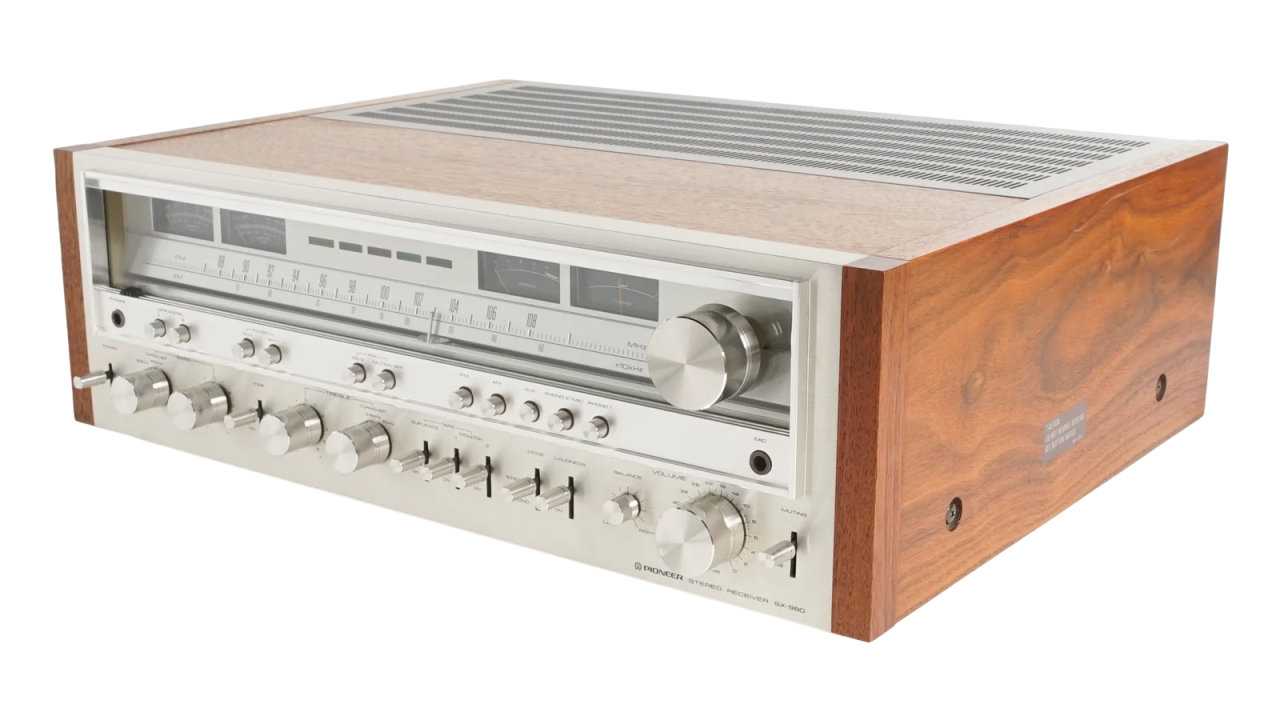
Pioneer Electronics – Introduction
Our next inductee is Pioneer Electronics, a Japanese Hi-Fi equipment manufacturer that was founded way back in 1937. Over the years, the company has produced many beautiful and high performing components that have been sold all over the world, making Pioneer one of the most iconic brands in Hi-Fi.
Let’s take a look at the history of this great company to see why it belongs in the Hi-Fi Hall of Fame.
Pioneer Electronics History: the Beginning
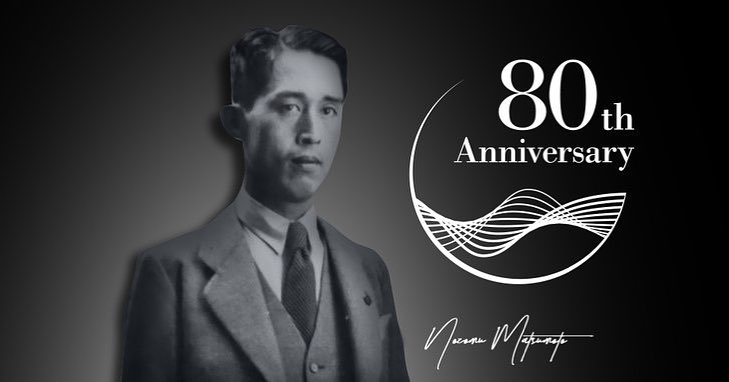
Nozomu Matsumoto (松本望) was a Japanese businessman and inventor who founded Pioneer Corporation. He was born in Kobe, Japan in 1905, the son of a Christian missionary. In 1936, he founded the Fukuin Shokai Denki Seisakusho company in Osaka, whose name roughly translates to “Blessed Sound Electric Company” or “Gospel Electric Company”, owing to Matsumoto’s Christian faith and belief that his electronic products could help in missionary works.

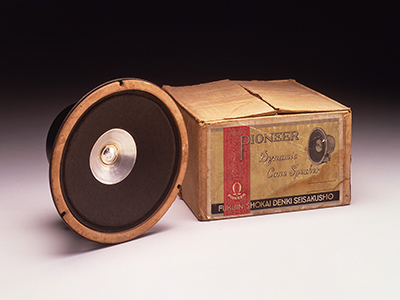
In 1937 he created the A-8 speaker which he called the “Pioneer”. Matsumoto relocated the business to Tokyo in 1938 and started a small factory which repaired radios and speakers.
After the war, the company expanded rapidly, and in the 1950s began producing electronics and turntables, primarily for the Japanese market. In 1961, the company officially changed its name to Pioneer Electronic Corporation.
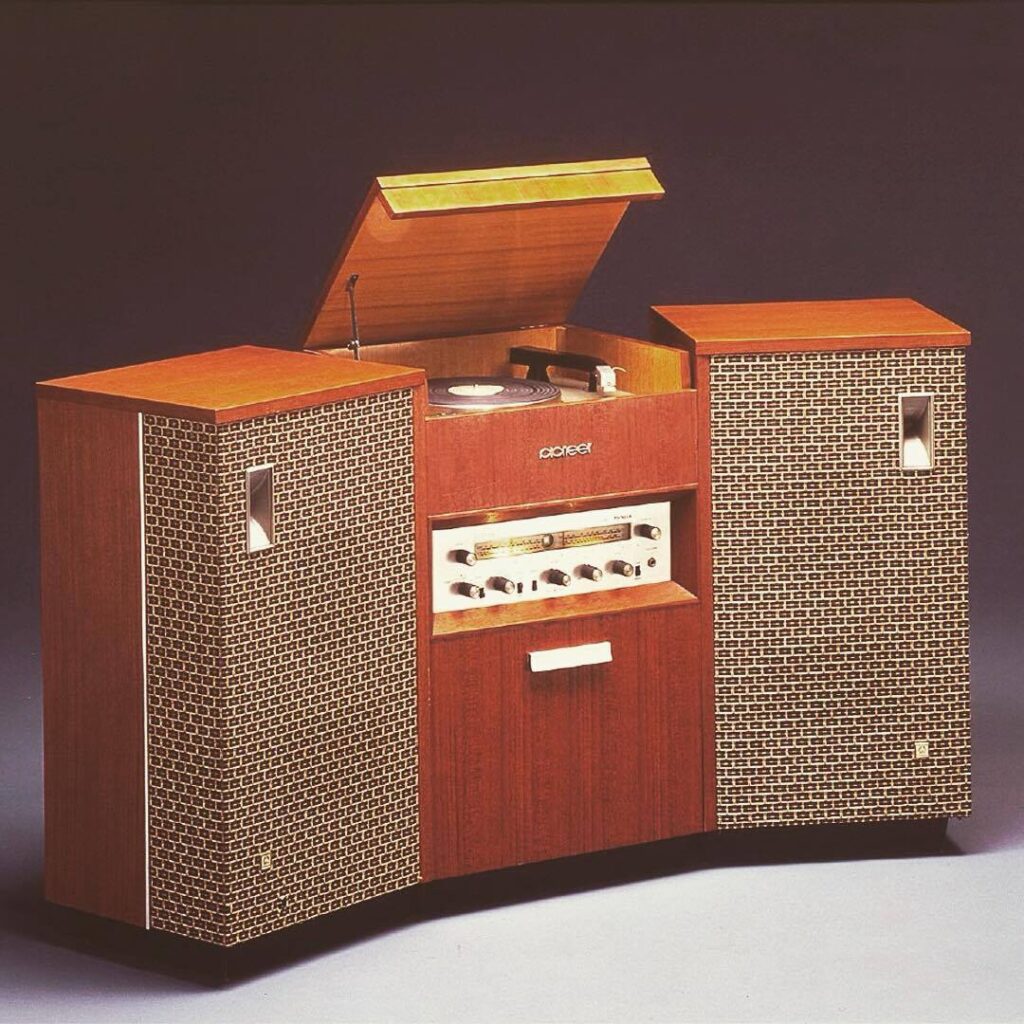
A year later, Pioneer introduced the PSC-5A, one of the world’s first separate stereo system. Before this, stereos were typically massive, one-piece furniture consoles. Pioneer’s “separates” allowed users to move the speakers apart for a better stereo image.
In 1966, the company established subsidiaries in the United States and Europe, beginning their dominance in the global Hi-Fi business.
The “Silver Era” of the 1970s
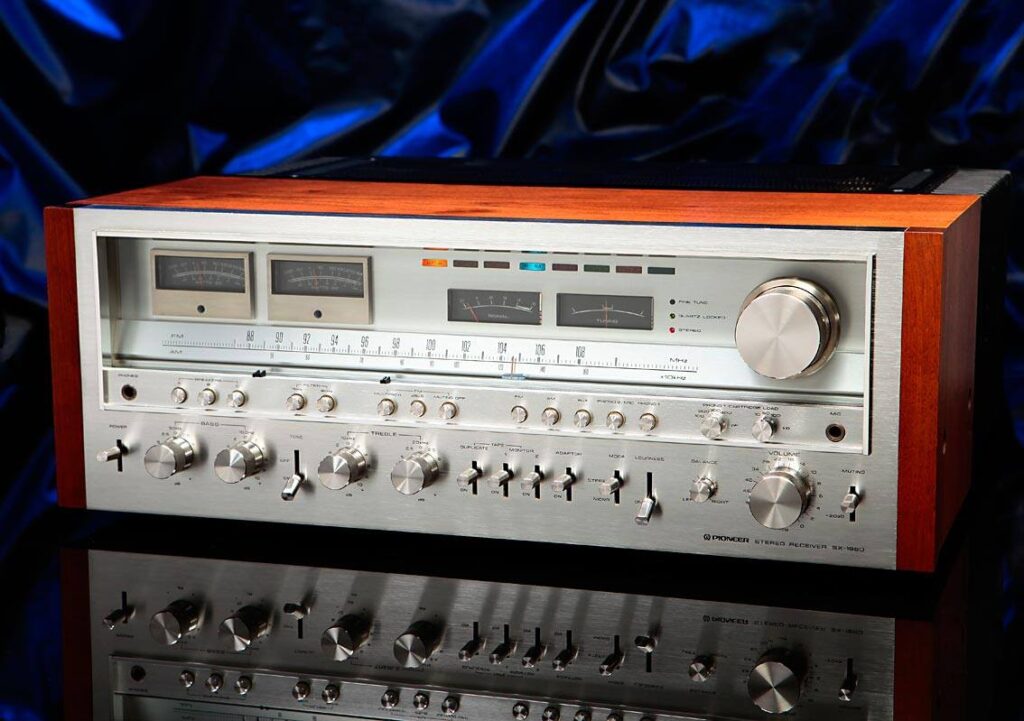
Pioneer is perhaps most famous among collectors for its equipment from the 1970s, often called the “Silver Era” because much of the equipment produced was fitted with silver-colored brushed aluminum faceplates. During this time, they produced some of the most powerful and iconic hi-fi receivers ever made, such as the SX-1980, which is still highly sought after by audiophiles today for its warm sound and brushed aluminum aesthetic.
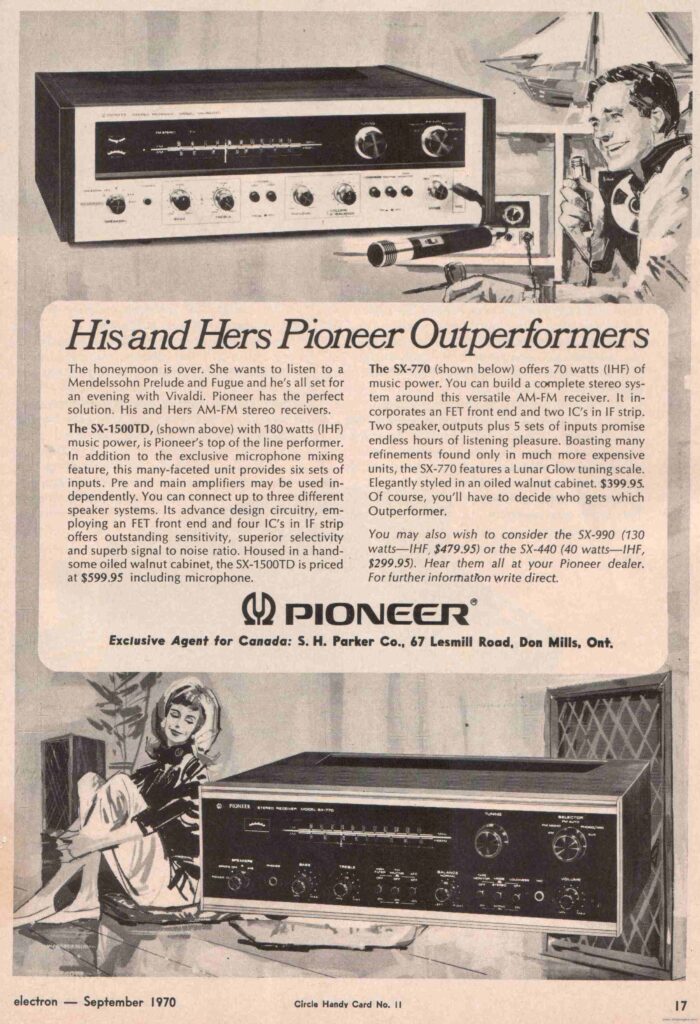
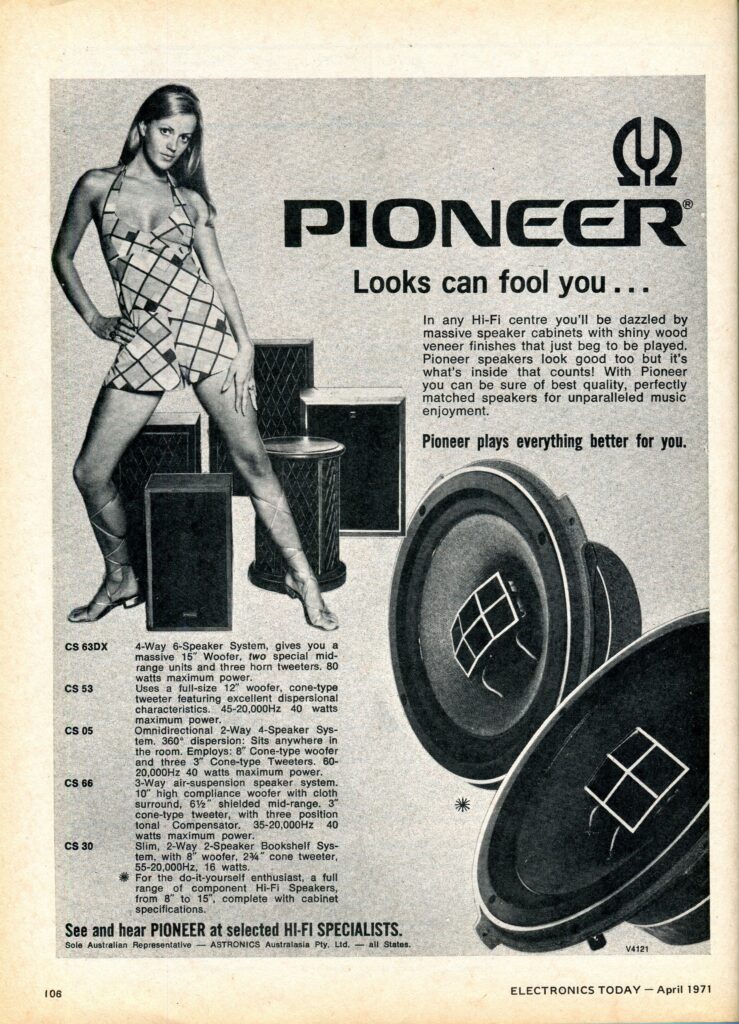
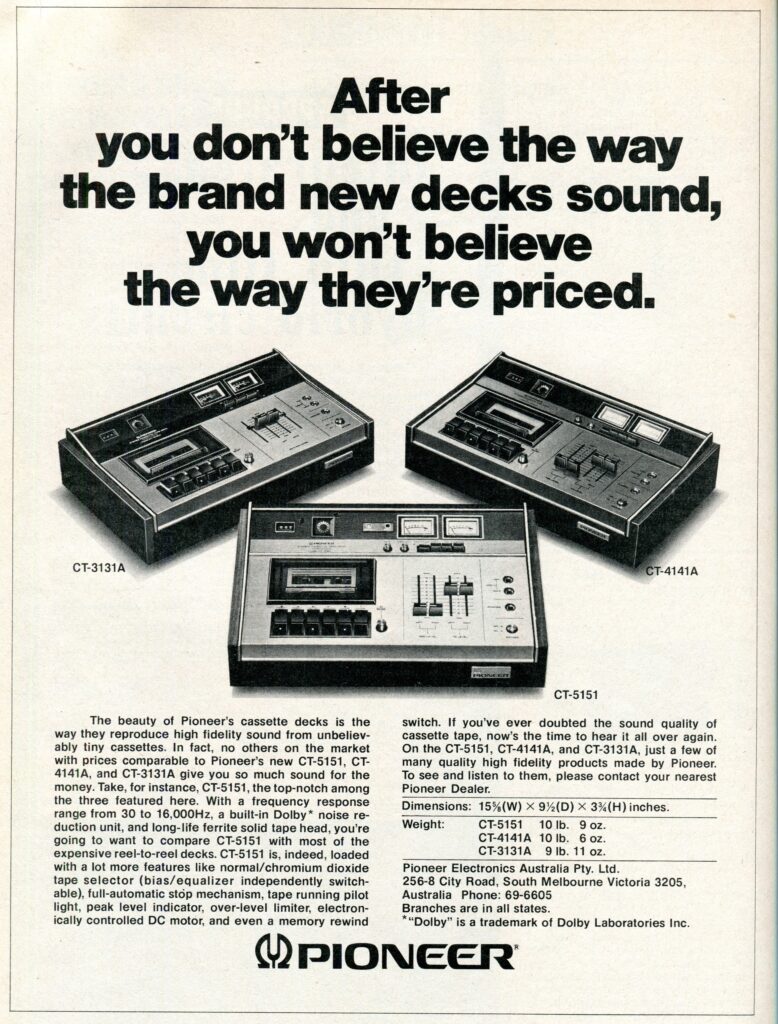
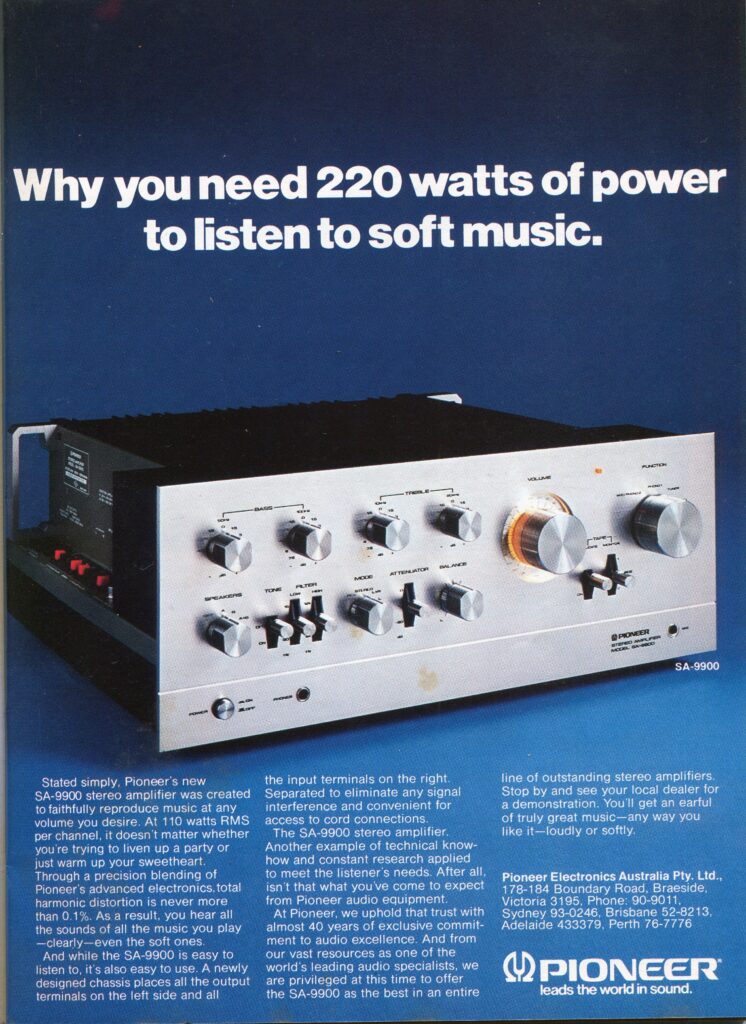
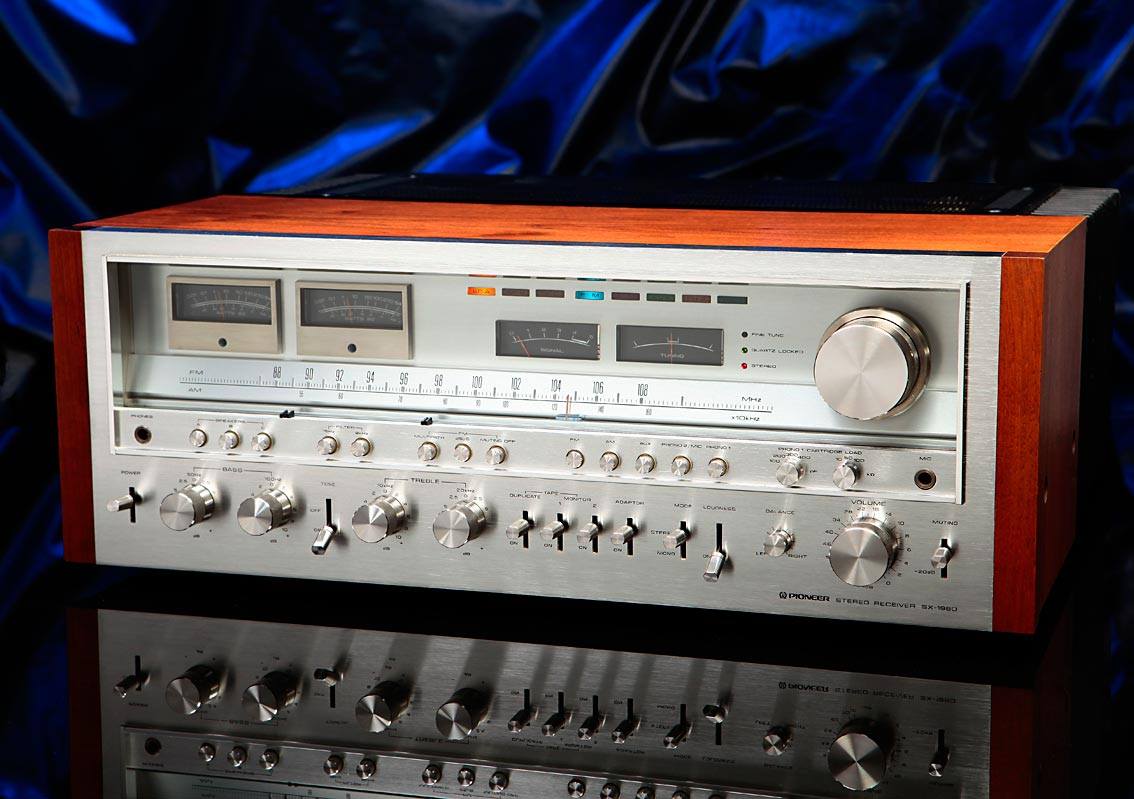
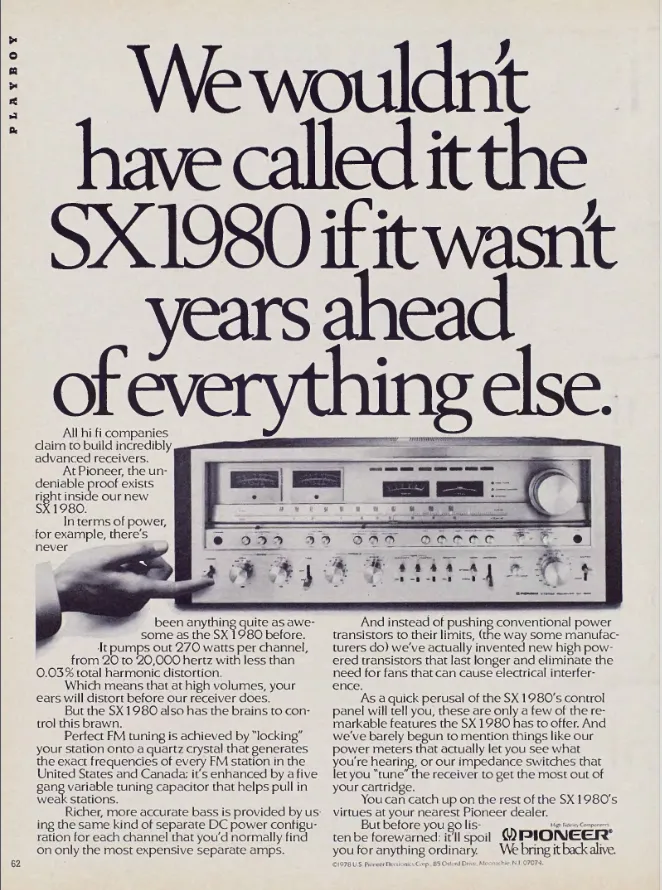
This era could also be called the “Bernie Mitchell” era. As its first director of marketing and later president, Bernie Mitchell helped build Pioneer America into one of the largest marketers of audio products in the U.S., growing from $2 million in sales a year (selling just seven products) to selling 125 products and generating $238 million per annum.
Mitchell aggressively expanded Pioneer’s American distribution network. While this created friction with traditional dealers accustomed to exclusive rights, it established Pioneer as the largest marketer of audio products in the U.S. at the time. Known affectionately by employees as “Uncle Bernie,” he was celebrated for his personal leadership style and for hosting company-wide gatherings at his home.

Digital and Optical Technologies Era: the 1980s
The 1980s marked a seismic shift in the high fidelity landscape, as the warm crackle of analog gave way to the precision of digital. This era saw a fundamental transition in how media was consumed, moving away from physical contact formats like vinyl records and magnetic tape toward the burgeoning world of optical storage. At the forefront of this revolution was Pioneer, a brand that didn’t just adapt to the digital age but actively pioneered the technologies that defined it.
Pioneer earned its reputation by being an aggressive early adopter of new technologies. While competitors often hesitated to leave analog behind, Pioneer integrated digital and optical technologies across their entire product ecosystem.
Pioneer’s catalog reads like a history book of consumer electronics. They were instrumental in the rollout of:
- Compact Disc (CD): They helped normalize digital playback for the masses.
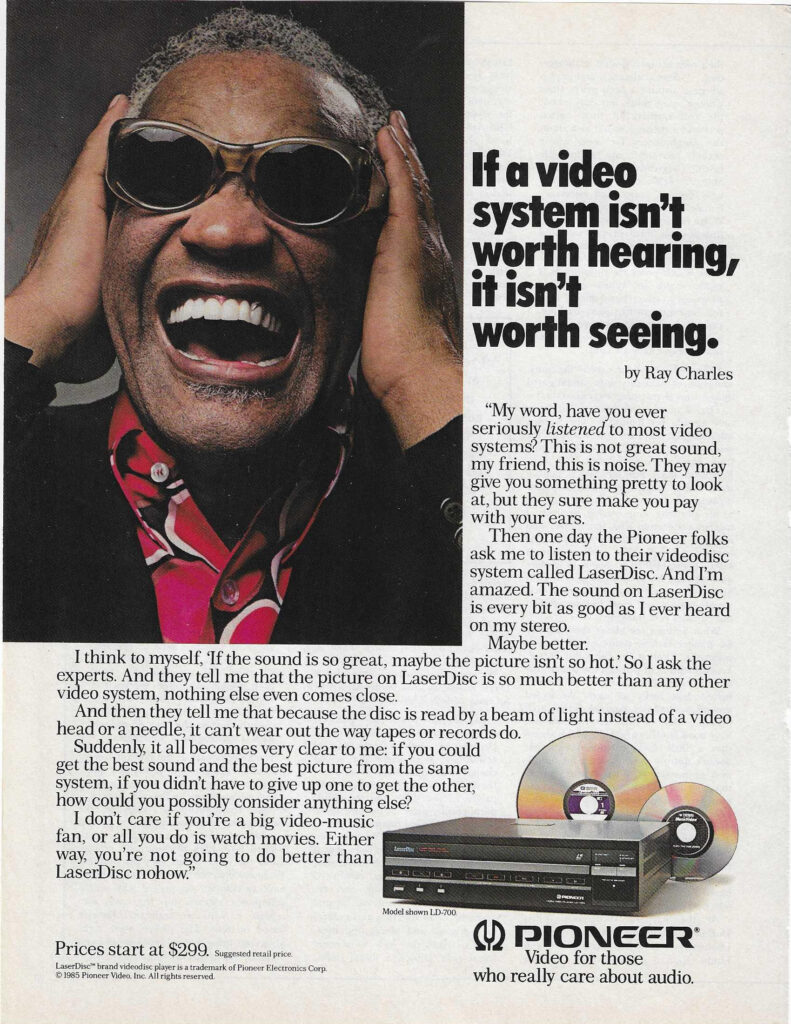
- LaserDisc (LD): Long before DVD, Pioneer championed the LaserDisc, launching their first model in 1980. They remained the format’s primary advocate for two decades, offering “cinephile” quality that eclipsed competitors such as VHS and Betamax.
- Digital Audio Tape (DAT) & MiniDisc (MD): They pushed the boundaries of high-quality digital recording for home users.
- Dolby Digital (AC-3): Pioneer was a crucial partner in bringing cinema-quality surround sound into the living room, bridging the gap between Hi-Fi and Home Theater.
- DVD-Audio & Network Streaming: they stayed ahead of the curve by embracing high-resolution multi-channel audio and the eventual transition to internet-based media.
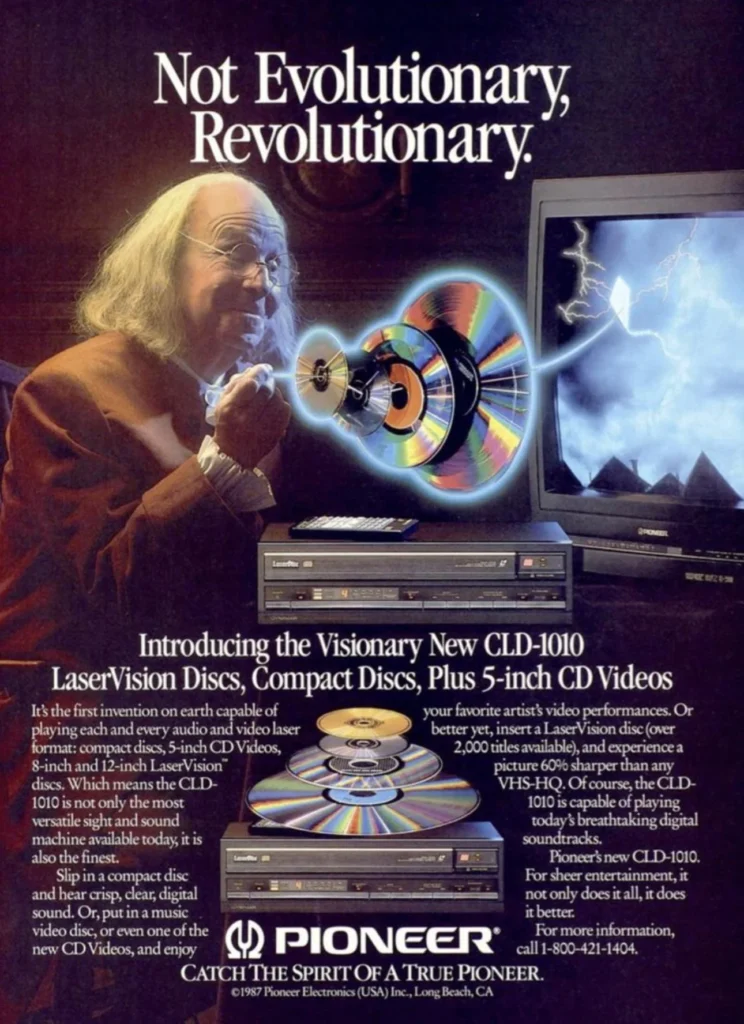
Throughout this decades-long period of disruption, Pioneer maintained its status as a cornerstone of the Hi-Fi industry. By blending traditional Japanese craftsmanship with a relentless pursuit of “The Next Big Thing,” they ensured that their hardware remained the centerpiece of audiophile setups worldwide. Whether it was the laser-guided precision of their players or the digital processing power of their receivers, Pioneer’s influence helped set the standards that modern digital audio still relies on today.
The 1990s: Navigation and the Digital DJ
The 1990s were characterized by Pioneer’s aggressive expansion into automotive intelligence and professional performance gear. In 1990, the company fundamentally altered the driving experience by introducing the AVIC-1, the world’s first GPS-based car navigation system available to the public. While early units were rudimentary by modern standards, they established the “Carrozzeria” brand in Japan as a titan in the aftermarket electronics industry.
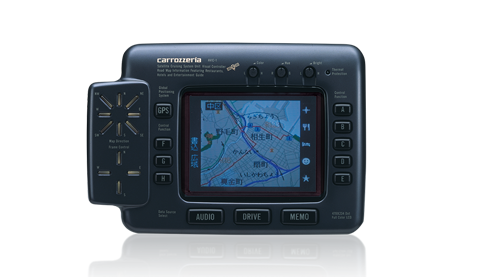
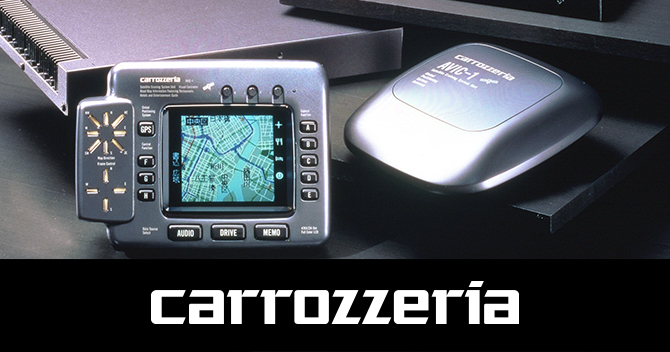
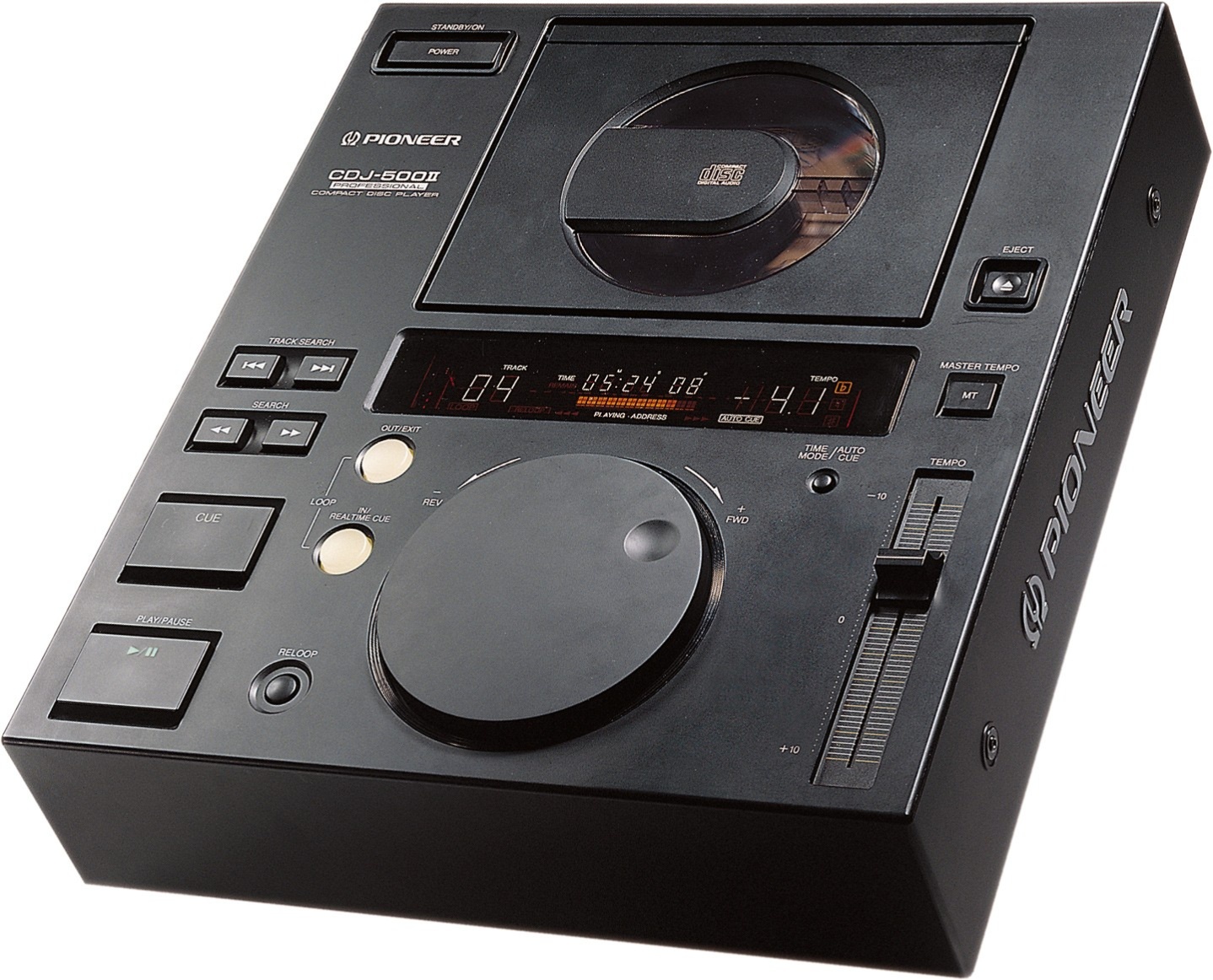
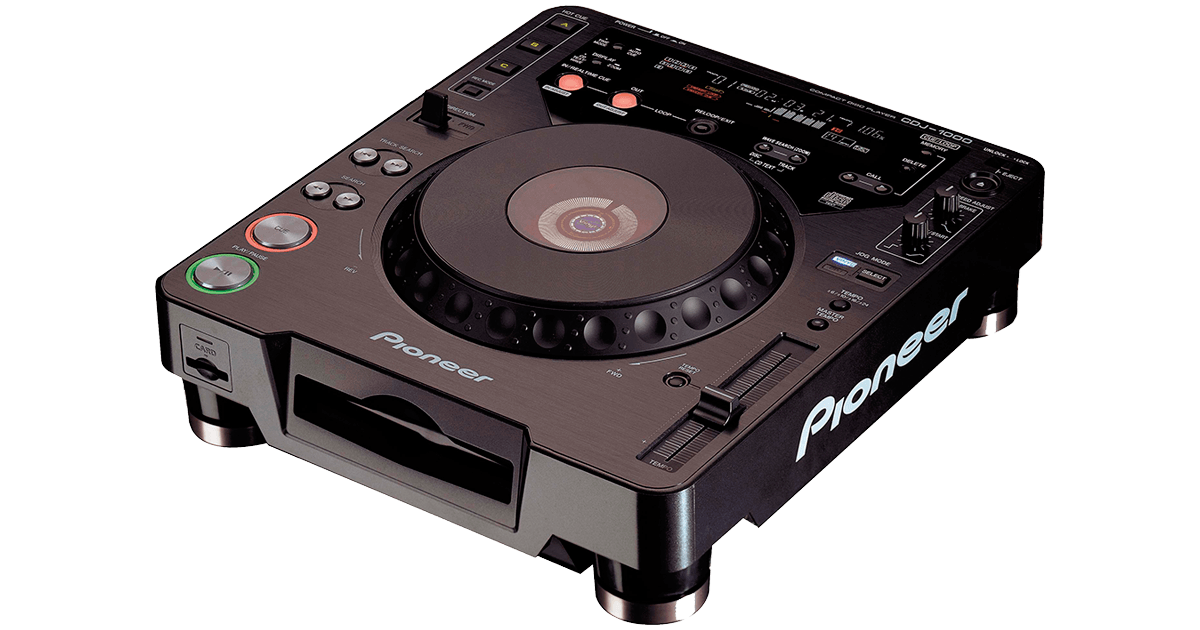
Simultaneously, Pioneer was staging a quiet revolution in the nightlife industry. In 1994, the release of the CDJ-500 marked the beginning of the end for the vinyl-only era. By creating a top-loading CD player with a “Jog Dial” that mimicked the tactile feel of a turntable, Pioneer provided DJs with the tools to manipulate digital audio with the same soul as analog records.
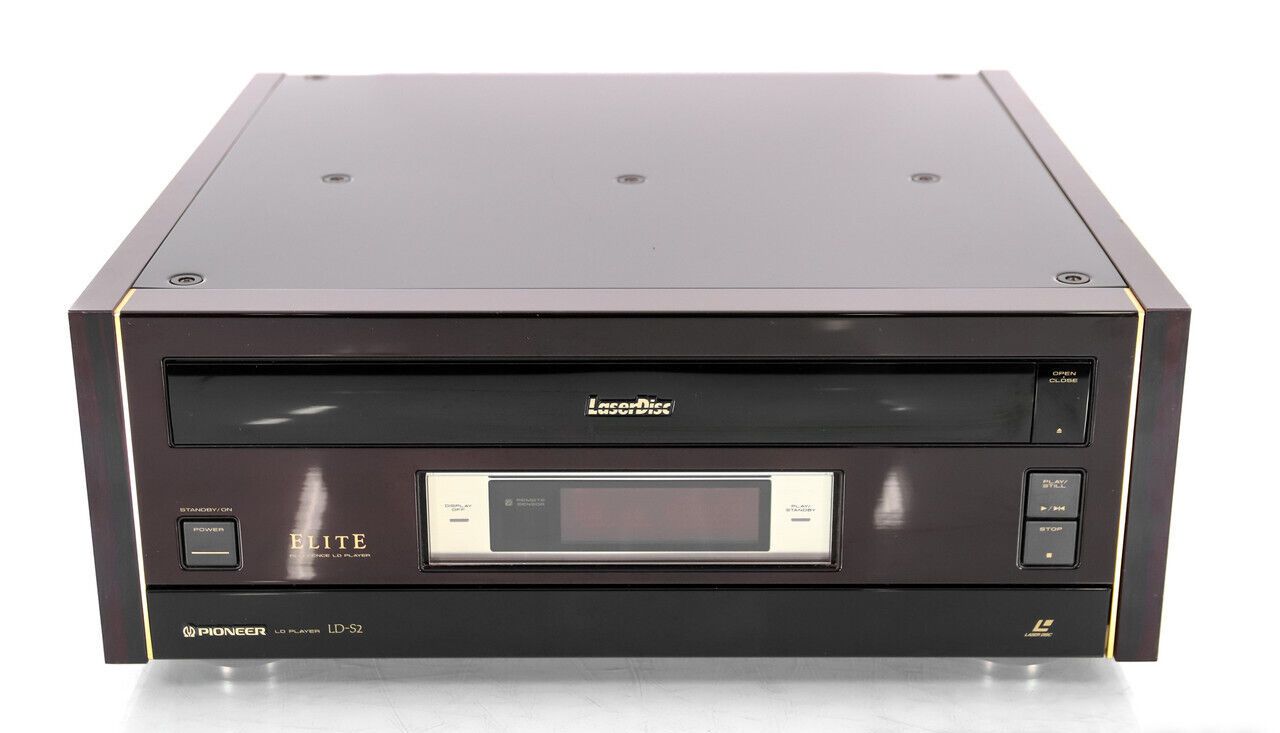
This era also saw Pioneer championing the LaserDisc format, especially through their “Elite” line, which featured the iconic “Urushi” glossy black finish which set a benchmark for premium home theater aesthetics.
The 2000s: Focus on the DJ Booth and the Pursuit of Video Perfection
As the new millennium began, Pioneer shifted its focus toward the professionalization of the DJ booth and a relentless quest for the perfect visual display. The 2001 release of the CDJ-1000 became a watershed moment for electronic music. It introduced “Vinyl Mode,” allowing DJs to “scratch” a CD as if it were a 12-inch record. This device quickly became the global club standard, a position the brand would hold for decades.
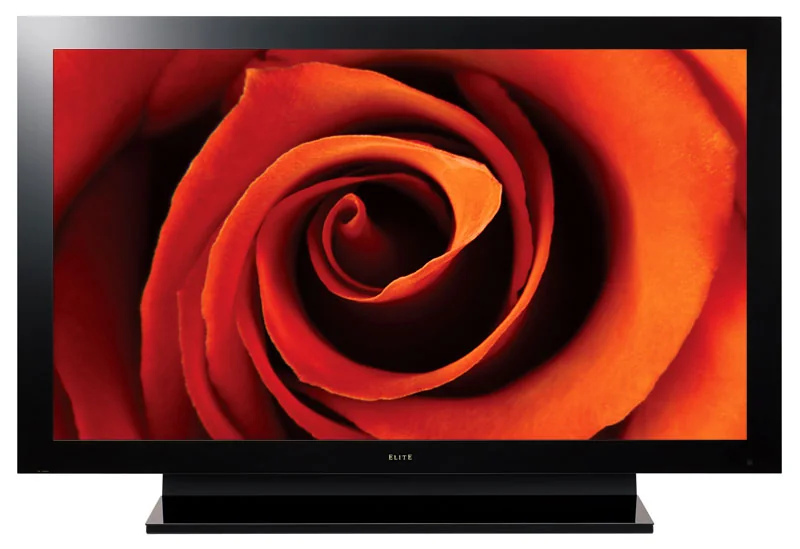
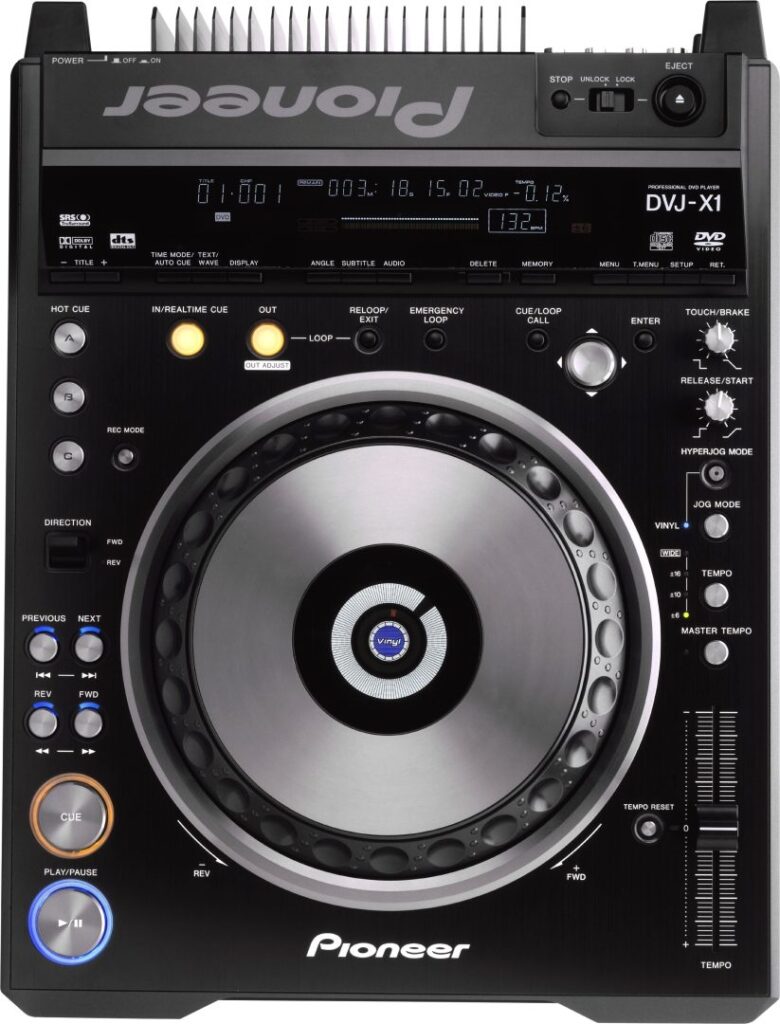
However, the crowning jewel of Pioneer’s engineering during the 2000s was undoubtedly the KURO plasma television. Launched in 2007, the KURO—named after the Japanese word for “black”—was a masterclass in display technology. By achieving unprecedented black levels and contrast ratios, Pioneer created a viewing experience that many videophiles argue has only recently been matched by modern OLED panels. During this same window, Pioneer continued to innovate in the car space, launching the first HDD-based navigation systems and even the DVJ-X1, which allowed DJs to manipulate video in real-time.
The Decline and Fall of Pioneer
Unfortunately for Pioneer, their share of the home Hi-Fi market was in steady decline. At the same time, despite Pioneer’s technical brilliance in the video business, the late 2000s brought significant economic challenges. The high production costs of plasma technology, combined with the rapid rise of cheaper, mass-produced LCD screens, forced Pioneer to make the difficult decision to exit the television market.
By 2015, it was clear that the company could not go on any longer. The company was eventually broken up and sold off in pieces, leading to a confusing end for its traditional Hi-Fi division. While you could still see the Pioneer logo on electronics, the original company that built the legendary 1970s gear effectively exited the home audio business.
The demise of Pioneer Electronics as a Hi-Fi manufacturer happened in three major steps:
2015: The Sale to Onkyo
Struggling with the decline of the traditional home audio market, Pioneer sold its entire Home Electronics division (receivers, Blu-ray players, and speakers) to its rival Onkyo. At this point, Pioneer Corporation shifted its focus almost entirely to car audio and navigation.
2022: The Voxx Takeover
After Onkyo went bankrupt in 2022, the rights to manufacture Pioneer-branded home audio gear were picked up by Premium Audio Company (PAC), a subsidiary of Voxx International. For a few years, they produced new Pioneer and “Pioneer Elite” receivers.
2025: The Final Curtain
In July 2025, PAC and Pioneer Corporation mutually agreed to end their licensing partnership. This meant that PAC would stop developing and selling new Pioneer home theater and hi-fi products. Support for existing models continues, but the once iconic Pioneer brand has effectively vanished from the consumer home audio market.
Despite their disappearance from the traditional Hi-Fi business, Pioneer is carrying on today as three new companies….more on this below.
Pioneer Electronics – Iconic Products
Before we look at the “new” Pioneer companies, let’s take a look back at some of Pioneer’s iconic products from their long and storied history of home Hi-Fi from 1937 to 2015.
A-8 Speaker
The Pioneer A-8 was the first high fidelity dynamic speaker ever made in Japan, and launched Pioneer as a Hi-Fi manufacturer in 1937.
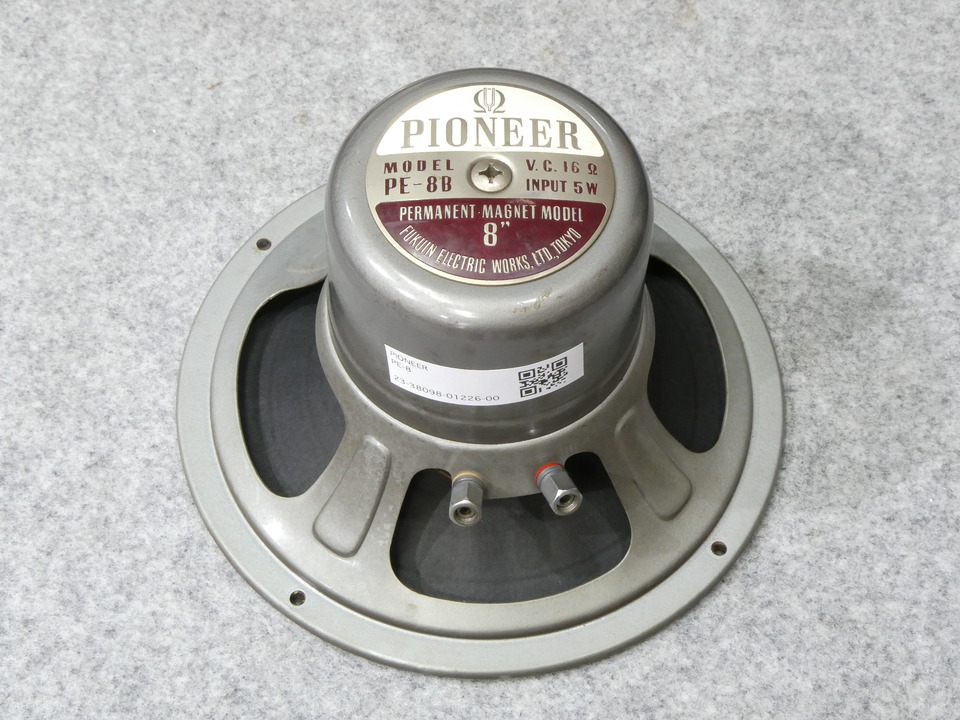
PE-8 Speaker
In 1953, the company introduced the PE-8, a dedicated hi-fi speaker that became a landmark product in the Japanese audio market.
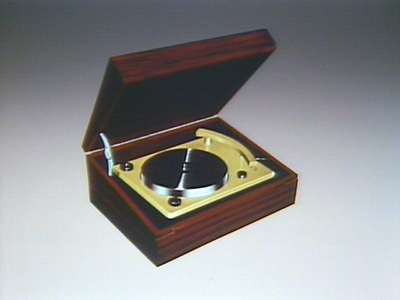
PLA-1 Turntable
Released in 1955, the Pioneer PLA-1 was an early professional transcription turntable designed for broadcast and high end Hi-Fi systems. Featuring a high-torque idler drive and a heavy platter, it helped establish Pioneer’s reputation for precision analog engineering.
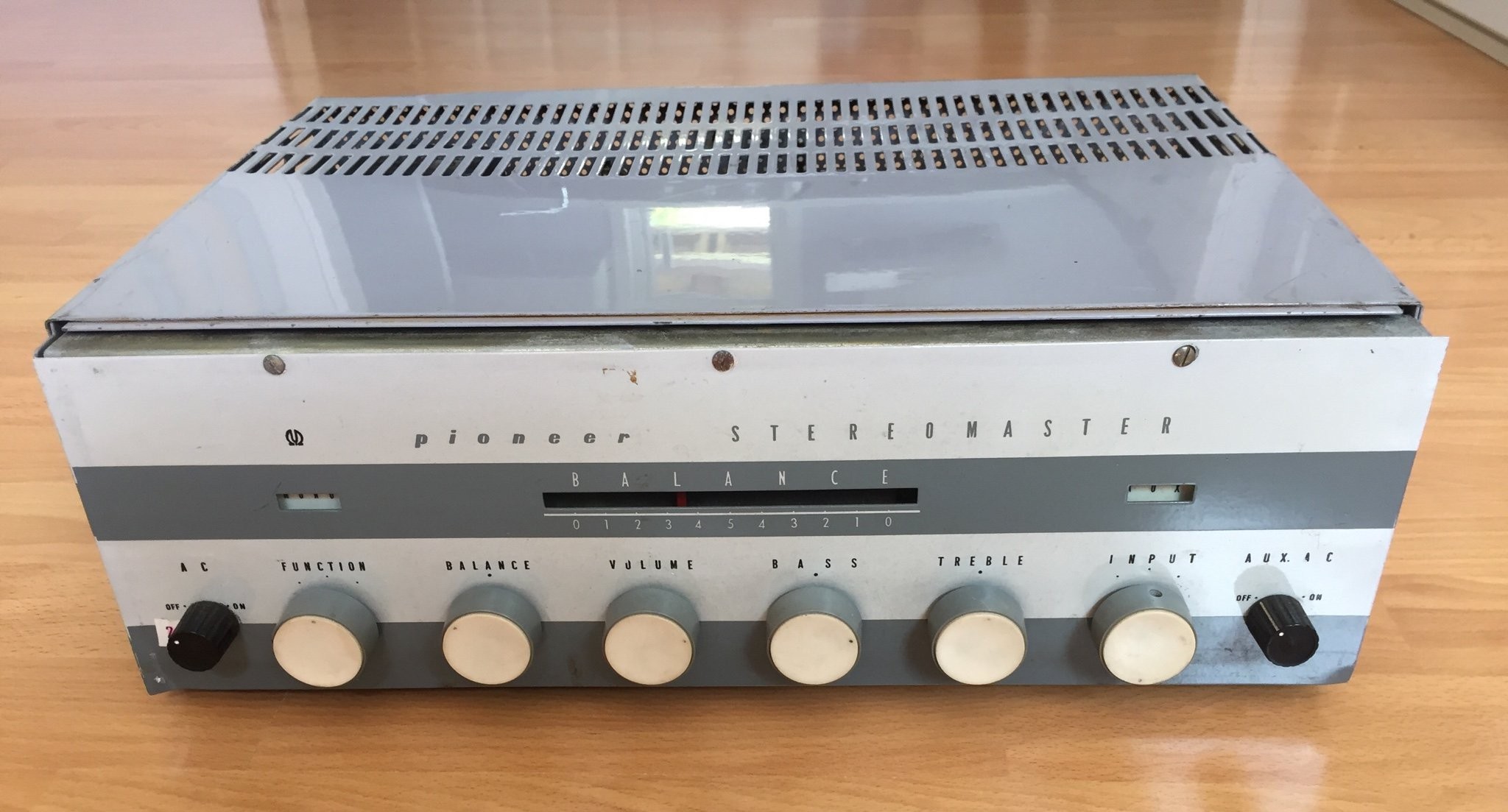
SM-R150 “Stereomaster” Amplifier
Launched in 1958, the SM-R150 was Pioneer’s first integrated stereo amplifier, designed to work with the era’s new stereo records.
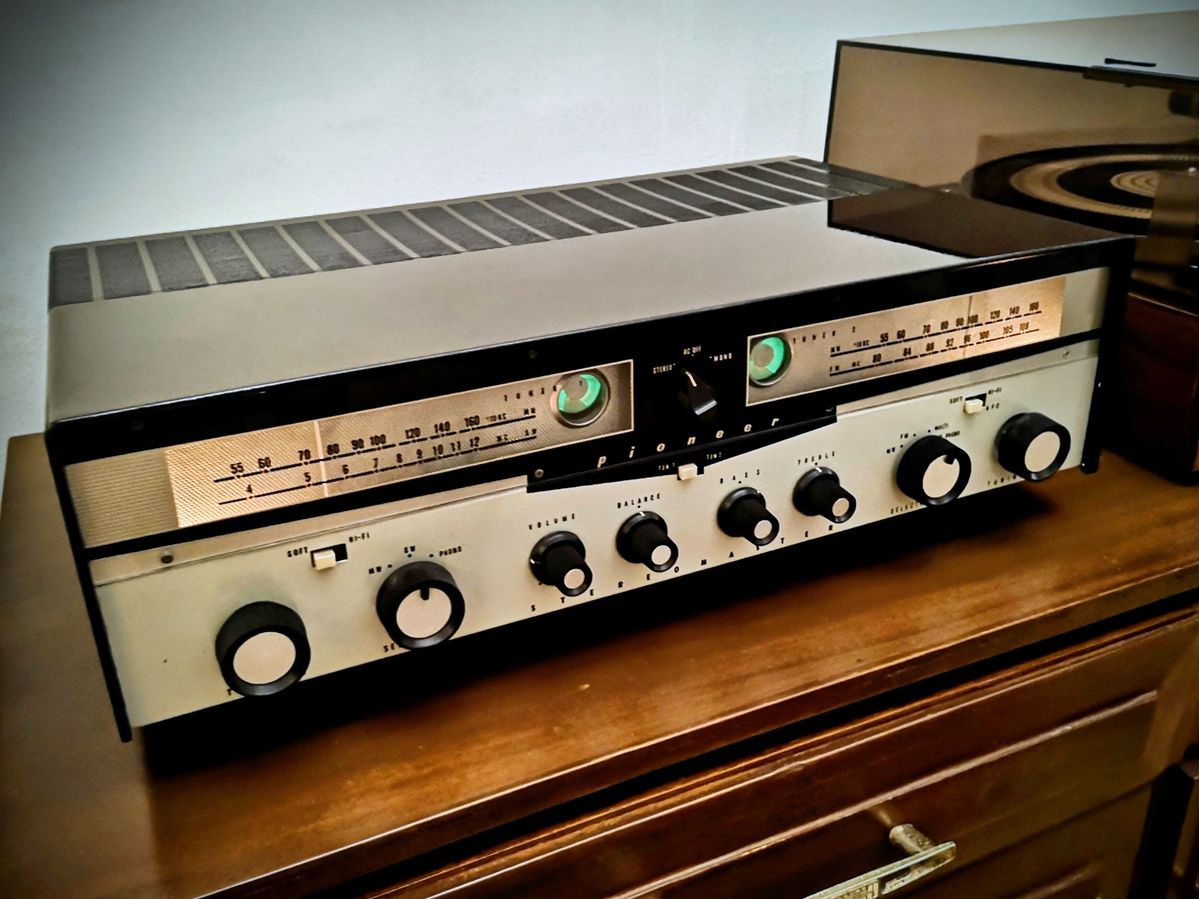
SM-Q410 Receiver
The SM-Q410 (1959) vacuum tube receiver featured dual tuners for early “simulcast” broadcast stereo.
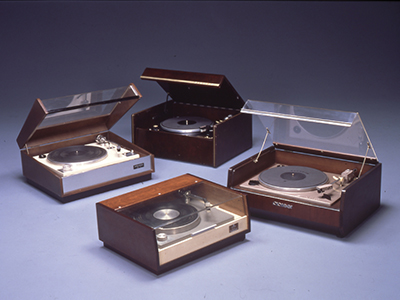
PL-3, PL-4, PL-5, and PL-6 Turntables
By the early 1960s, Pioneer had a wide range of Hi-Fi turntables:
- PL-3 Belt-Drive was a high-fidelity “studio-type” turntable with a heavy die-cast platter, designed for low vibration and consistent speed.
- PL-4 Professional was Pioneer’s premier 1962 model; it featured a massive synchronous motor and a specialized “stay-put” oil-damped tonearm.
- PL-6 Auto-Return was one of Pioneer’s earliest attempts at automation, combining high-mass build quality with a convenient auto-stop mechanism.
- PL-7 Manual/Compact was a streamlined version of the PL-4, often sold as a standalone motor and platter for custom console installations.
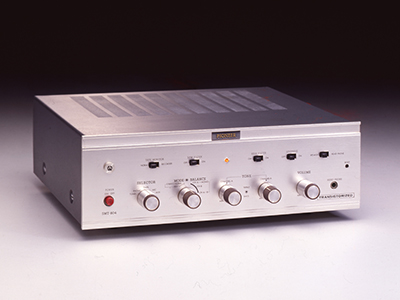
SMT-804 Amplifier
Introduced in 1965, the SMT-804 was one of Pioneer’s first all-transistor integrated stereo amplifiers, marking Pioneer’s transition from vacuum tubes to solid-state technology.
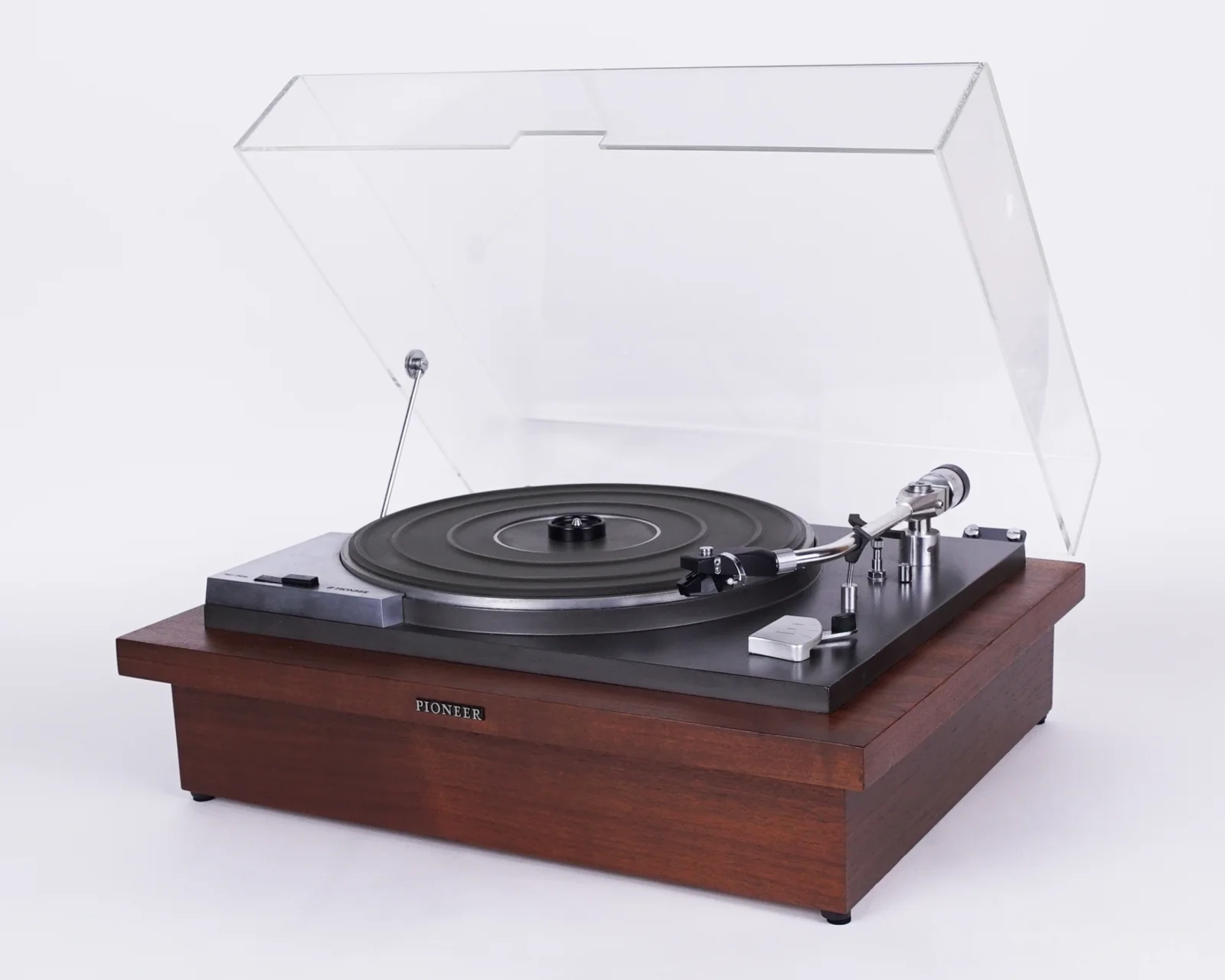
PL-41 Turntable
The Pioneer PL-41 turntable, launched in 1965, was a professional-grade manual belt-drive turntable featuring a massive die-cast platter and a luxurious walnut-veneered plinth.
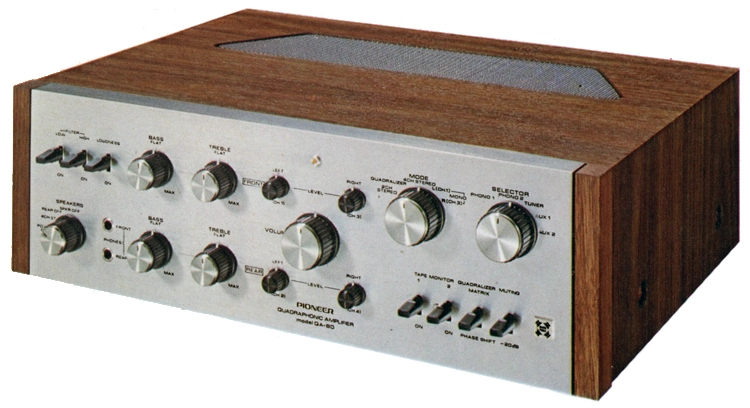
QA-80 Quadraphonic Amplifier
Pioneer offered the QA-80 in 1971, it was a “quadraphonic” integrated amplifier featuring four channels and “Quadralizer” circuitry to create immersive surround sound.
RT-1050 Open Reel Recorder
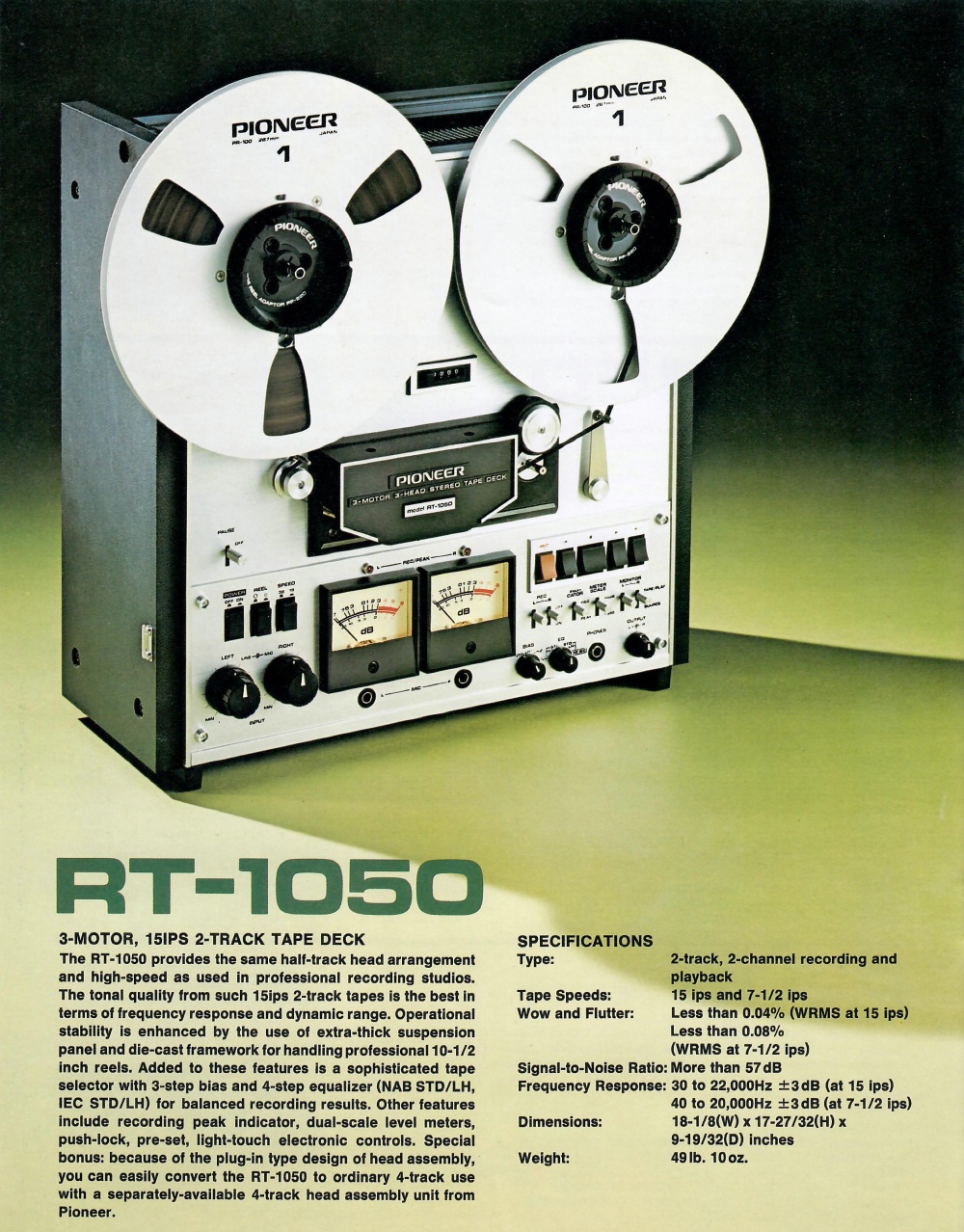
In 1973, Pioneer launched the RT-1050 Open Reel Recorder, a high-speed (15 inch-per-second), 2-track reel-to-reel tape deck featuring 10.5-inch reel capacity and a modular, plug-in head system.
HPM-100 Speaker (1976)
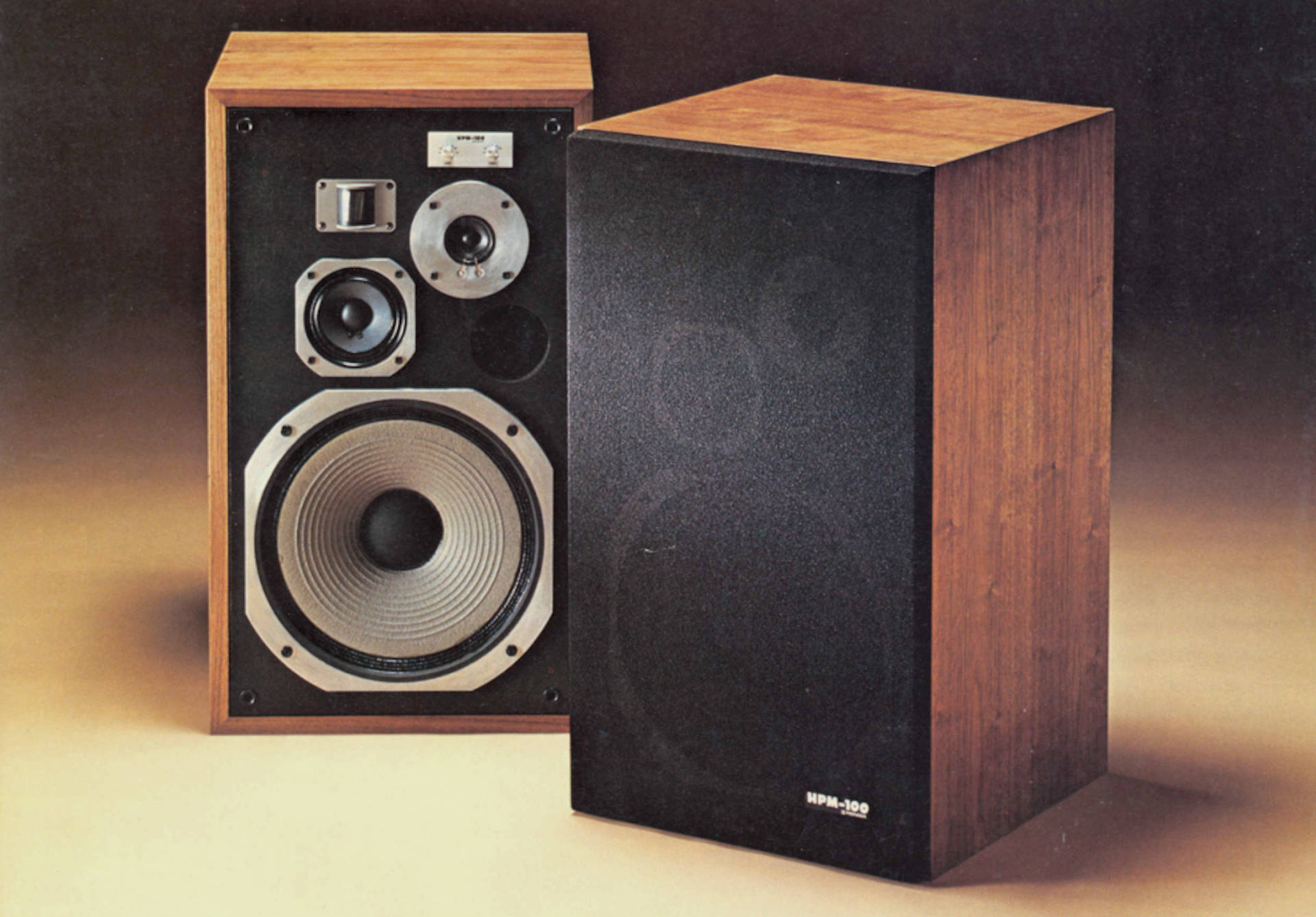
In 1976 Pioneer released the HPM-100 4-way bass reflex speaker which used a high-polymer film super tweeter; this speaker was designed to compete with the very popular JBL L100 “Century”.
RT-707 Open Reel Recorder
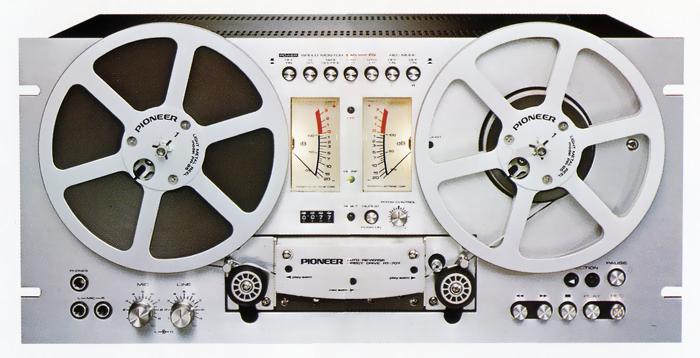
1977 saw the release of the RT-707, a 4-track, 3-motor rack-mount reel-to-reel deck featuring auto-reverse playback, direct-drive stability, and legendary “built-like-a-tank” durability.
SX-1280 Receiver
In the late 1970s, Hi-Fi manufacturers were in a power war, selling some very high powered amplifiers and receiver; Pioneer’s contribution was 1977’s SX-1980 stereo receiver, delivering 185 watts per channel, and featuring distinctive black-faced power meters and a massive toroidal transformer.
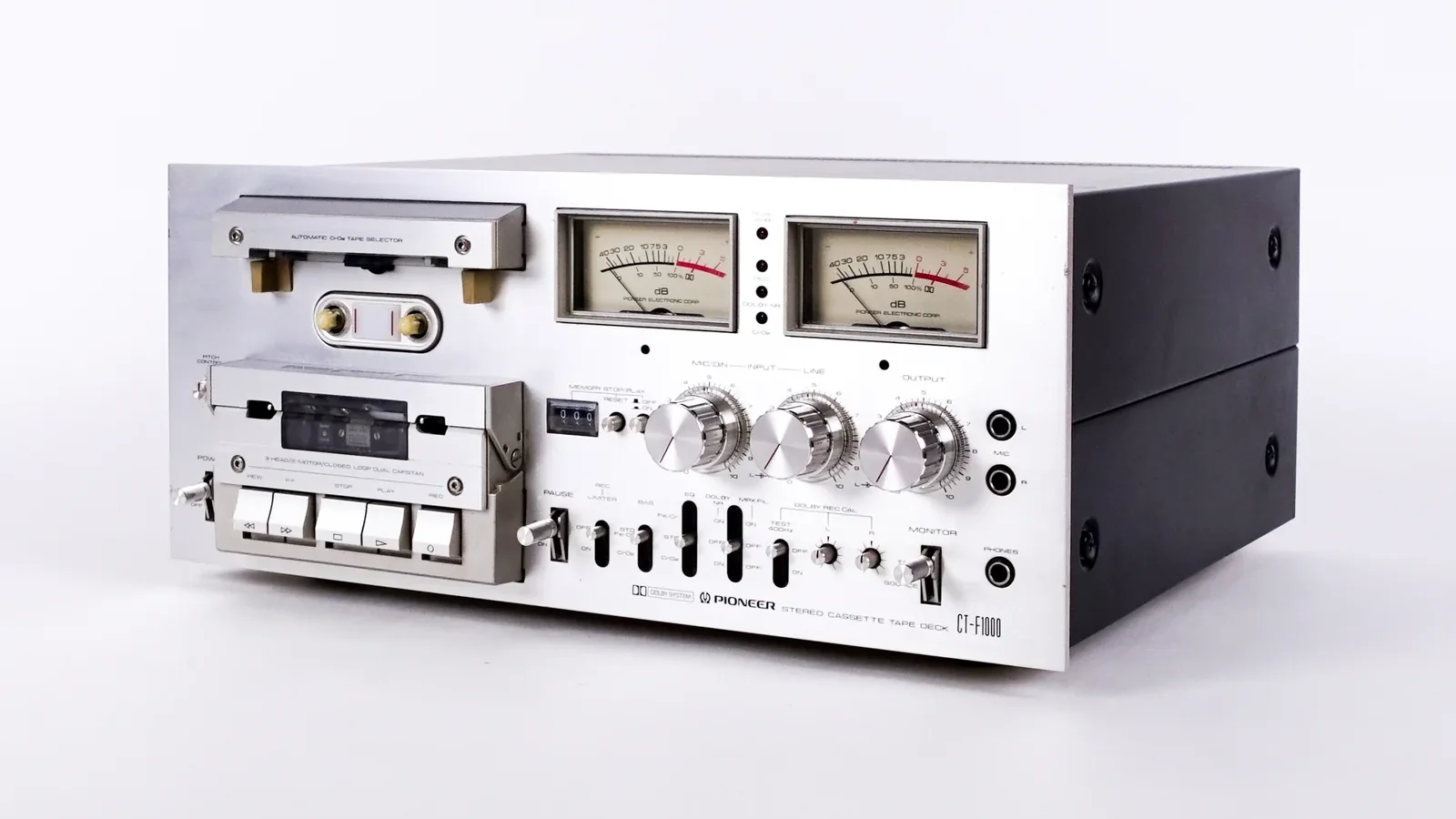
Pioneer CT-F1000 Cassette Deck
The Pioneer CT-F1000 (1977) was a full featured cassette deck including automatic Chromium-Dioxide (Cr02) tape detector, multiple bias and equalization settings, pitch control, memory stop, Multiplex filter, tape slack canceller, and solenoid operated controls
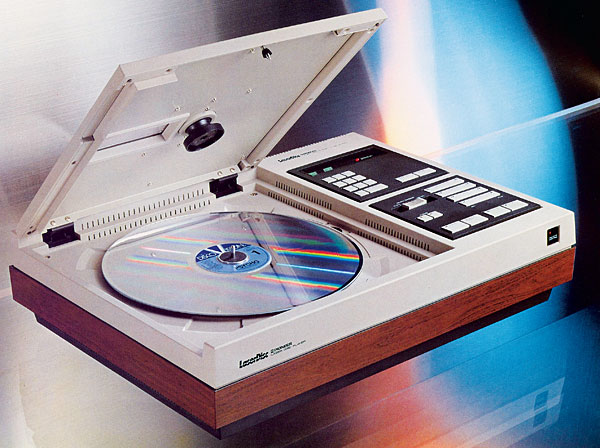
VP-1000 LaserDisc Player
The VP-1000, released in 1980, was a landmark LaserDisc player. It introduced high-quality optical video and stereo sound to home theaters using “LaserVision” technology.
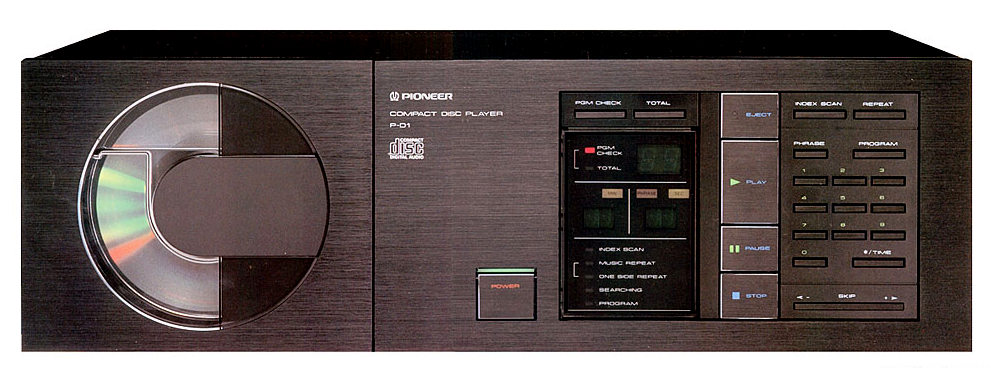
P-D1 Compact Disc Player
Released in October 1982, the Pioneer P-D1 was Pioneer’s first ever Compact Disc player. It is a legendary piece of hi-fi history, released alongside the very first wave of CD players like the Sony CDP-101.
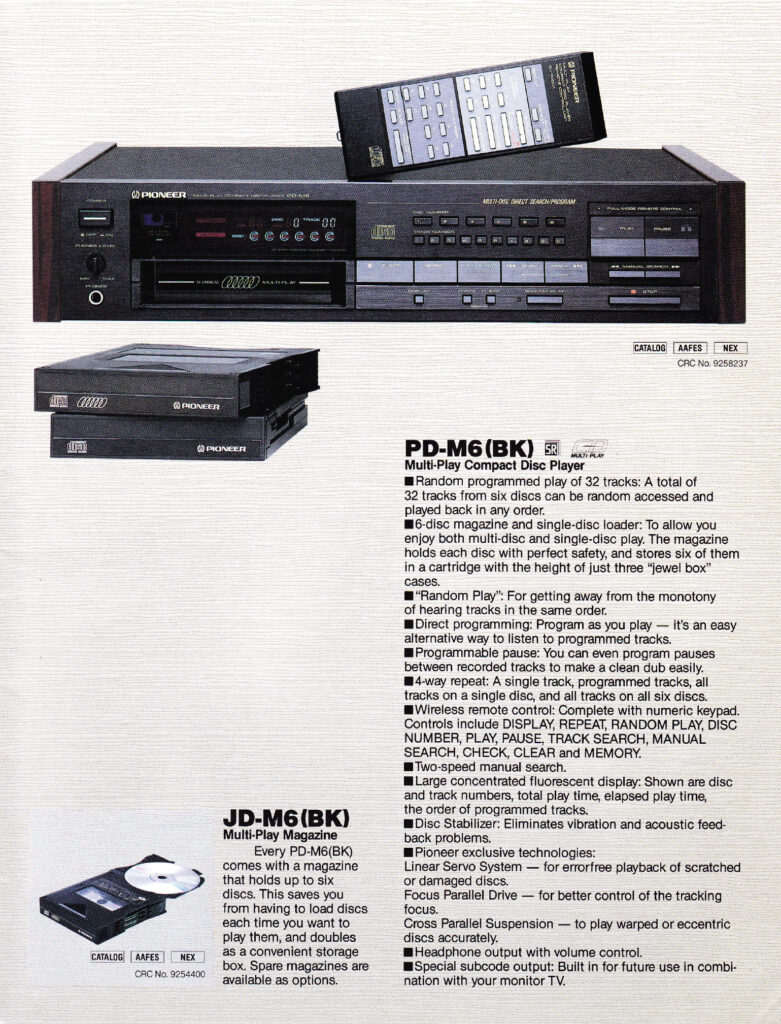
PD-M6 Compact Disc Player
Released in 1985, the Pioneer PD-M6 was a significant device in digital audio history: it was the world’s first magazine-style CD changer. While other manufacturers mostly employed “carousel” designs, Pioneer’s magazine system became an industry standard for over a decade, especially in automotive audio, where the cartridge was very convenient.
D-1000 DAT recorder
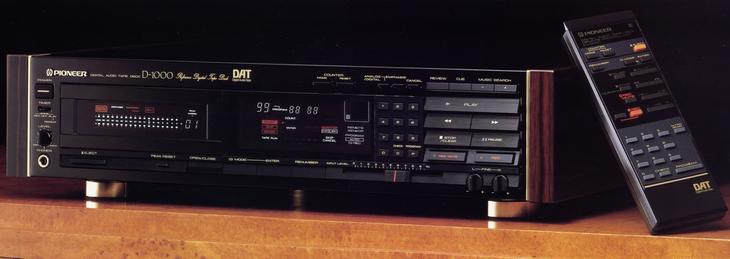
Released in 1987, the Pioneer D-1000 was the company’s first ever Digital Audio Tape (DAT) recorder. It was a flagship statement piece, built to prove that Pioneer could compete in the then-revolutionary field of digital recording.
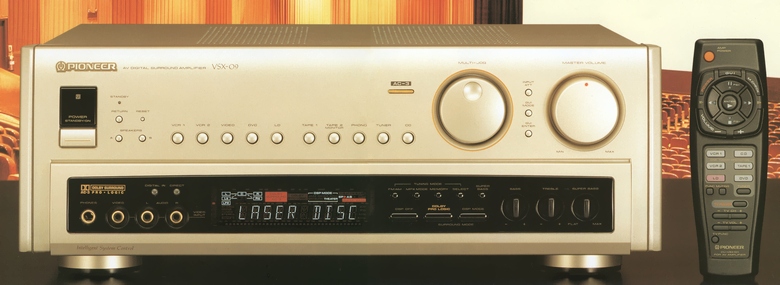
VSX-09 Receiver with Dolby Surround AC-3
Released in 1995, the Pioneer VSX-09 was a high end Audio/Video receiver that marked a major transition in home theater history: the move from analog Dolby Pro Logic to Dolby Digital (AC-3). The VSX-09 was one of the first consumer receivers to feature a built-in Dolby Digital AC-3 decoder. Before this, users typically had to buy an expensive external processor to get discrete 5.1-channel digital sound. It was designed to be the centerpiece of a high-end system, particularly for those using Pioneer’s LaserDisc players with AC-3 RF outputs.
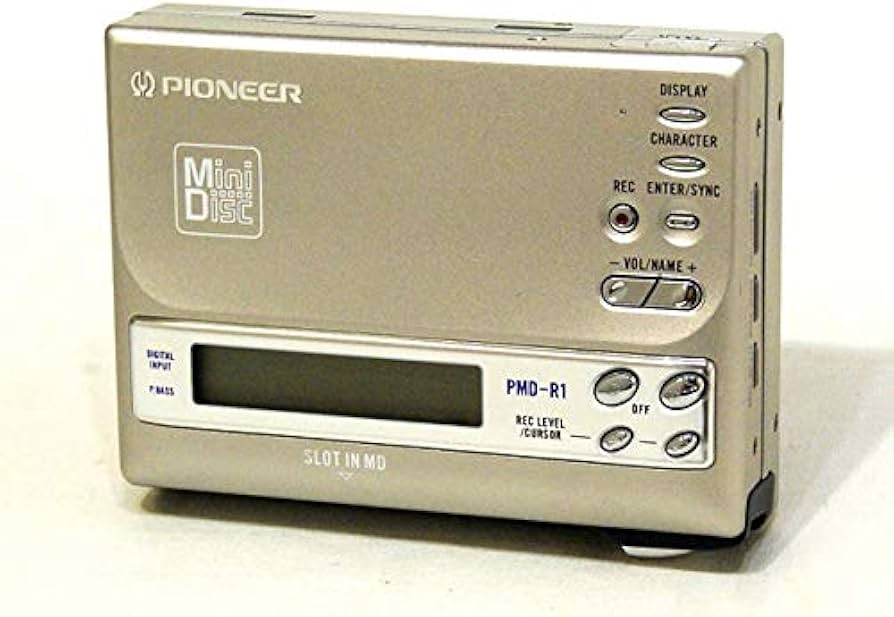
PMD-R1 MiniDisc Recorder
Released in 1995, the Pioneer PMD-R1 was Pioneer’s first portable MiniDisc recorder. It was a high-end “Walkman” style device designed to compete with Sony’s dominant MZ-R series.
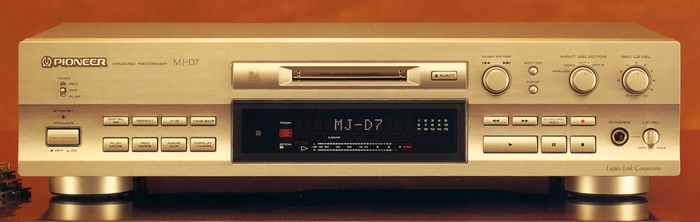
MJ-D7 MiniDisc Recorder
Released in April 1998, the Pioneer MJ-D7 was a premium, full-sized MiniDisc recorder. It was marketed as a high-fidelity alternative to the dominant Sony decks, focusing on sound quality rather than just portability.
PD-F908 CD Changer
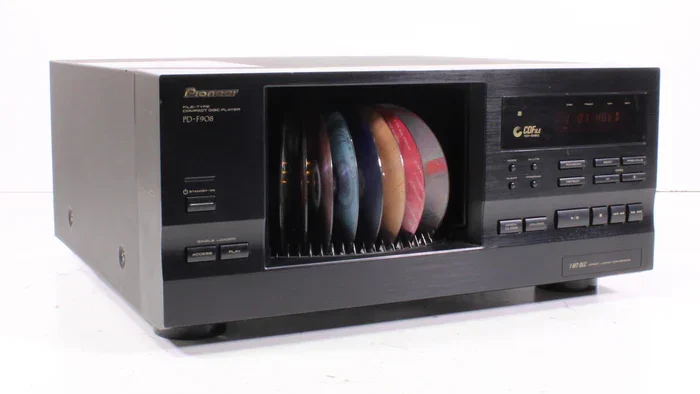
Released in May 1999, the Pioneer PD-F908 was a carousel type CD changer designed for high-capacity storage and playback. It was a “mega-changer” that allowed music collectors to load up to 101 Compact Discs inside the machine, effectively acting as a home jukebox.
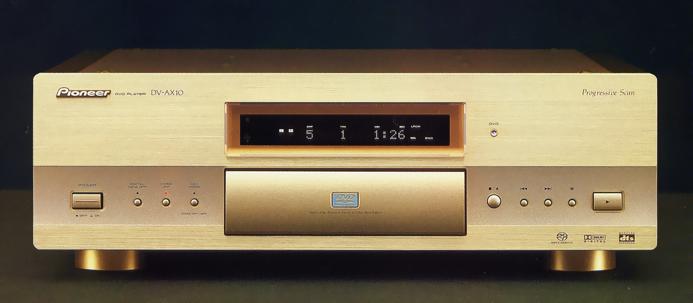
DV-AX10 DVD-Audio / SACD player
Released in 1999, the Pioneer DV-AX10 was a “universal” player that solved the “format wars” between competing digital audio formats. It was capable of playing SACD (Super Audio CD), DVD-Audio, DVD-Video, and CD discs.
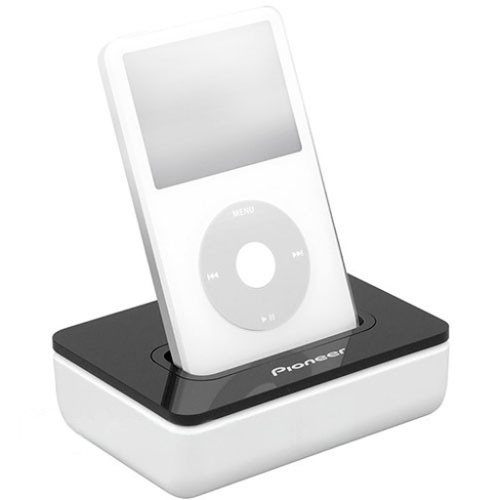
IDK-01 iPod Dock
Released in 2007, the Pioneer IDK-01 was a universal docking station designed to integrate the Apple iPod (which was then at the height of its popularity) into home audio systems.
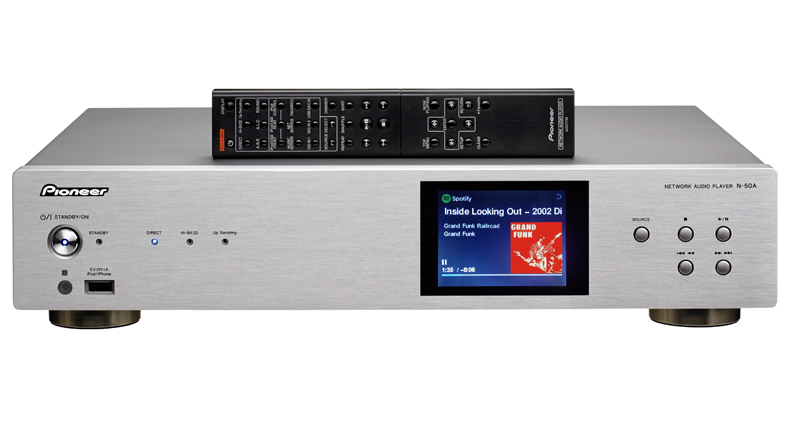
N-50 Network Audio Player
The Pioneer N-50, introduced in 2011, was a flagship music streamer that supported some early streaming capabilities such as AirPlay, DLNA 1.5, and vTuner Internet Radio. It was among the first consumer streamers to support high-resolution files like 192kHz/24-bit FLAC and WAV via a network or USB. It was built to look like a traditional high-end hi-fi separate, featuring a brushed aluminum faceplate and a small color LCD for album artwork.
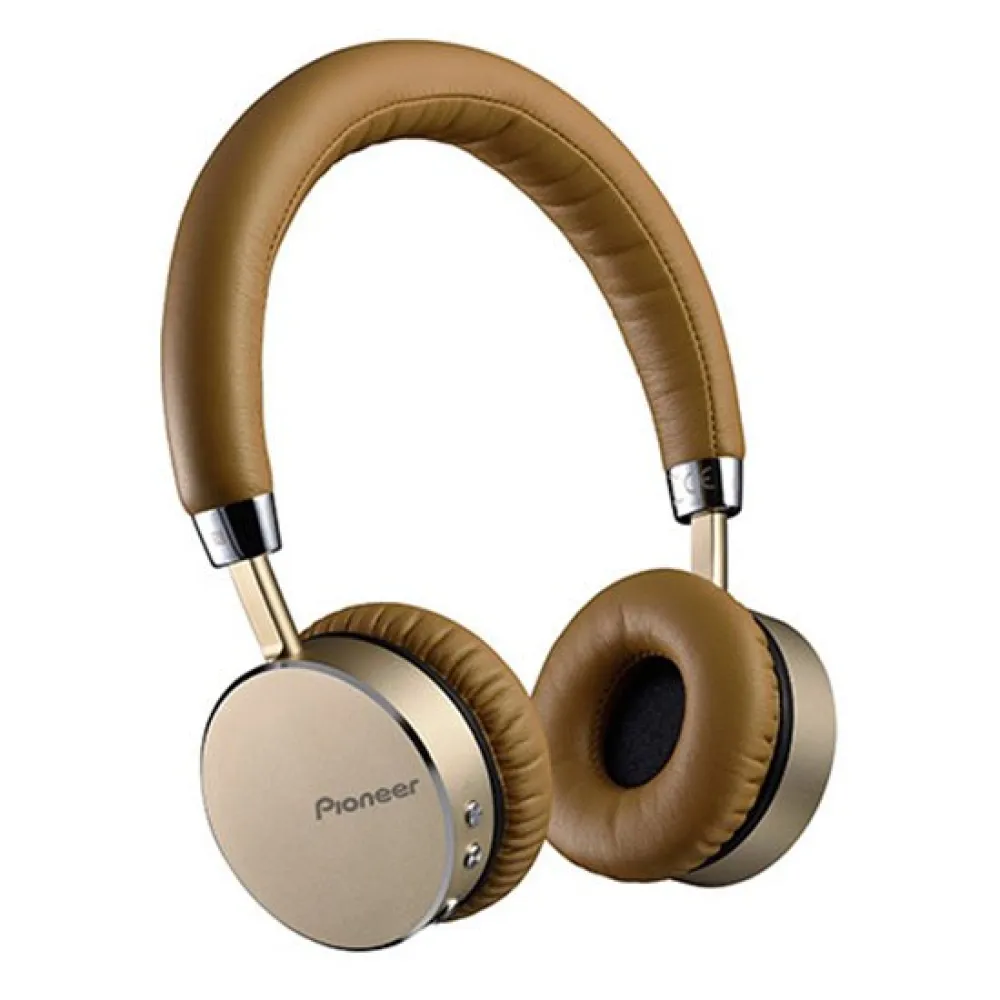
SE-MJ561BT-S Headphones
Released in 2015, the Pioneer SE-MJ561BT-S were wireless headphones; these have the distinction of being one of the final products released by Pioneer before the company’s sale to Onkyo.
Pioneer Electronics Today
Despite the end of it’s traditional home Hi-Fi business, Pioneer today continues to operate as three separate companies. Let’s take a brief look at each of those to see how Pioneer’s legacy is being honored today.
Pioneer Corporation
The first company is “Pioneer Corporation” which focuses on automotive “infotainment” systems, smart cockpits, and car audio. They continue Pioneer’s long tradition of making speakers and other high quality equipment for the car. Here are a few of their current products:
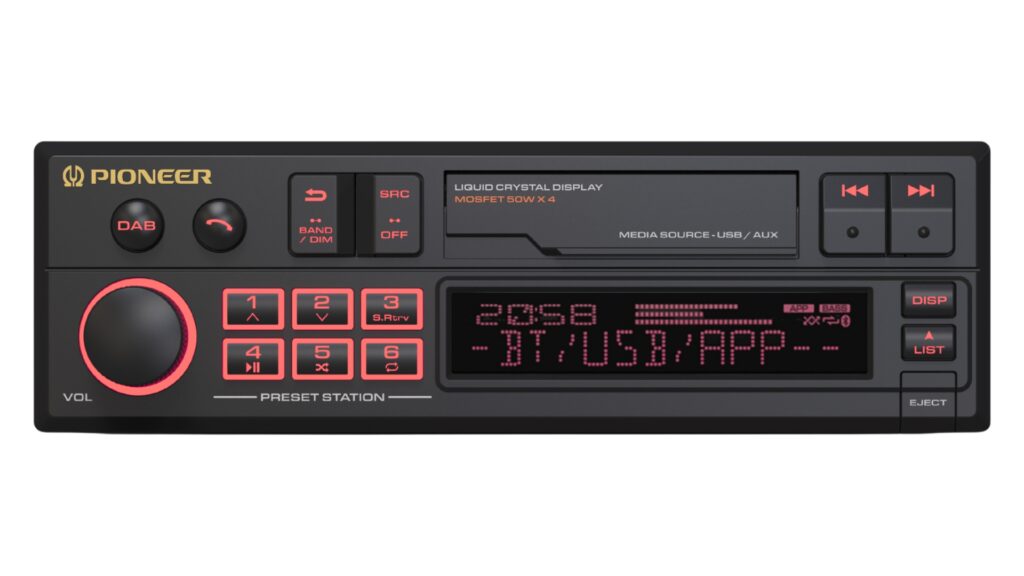
SXT-C10PS Car Radio
The Pioneer SXT-C10PS is a modern car radio with vintage aesthetics and state-of-the-art audio technology. It was specially designed for classic vehicles.
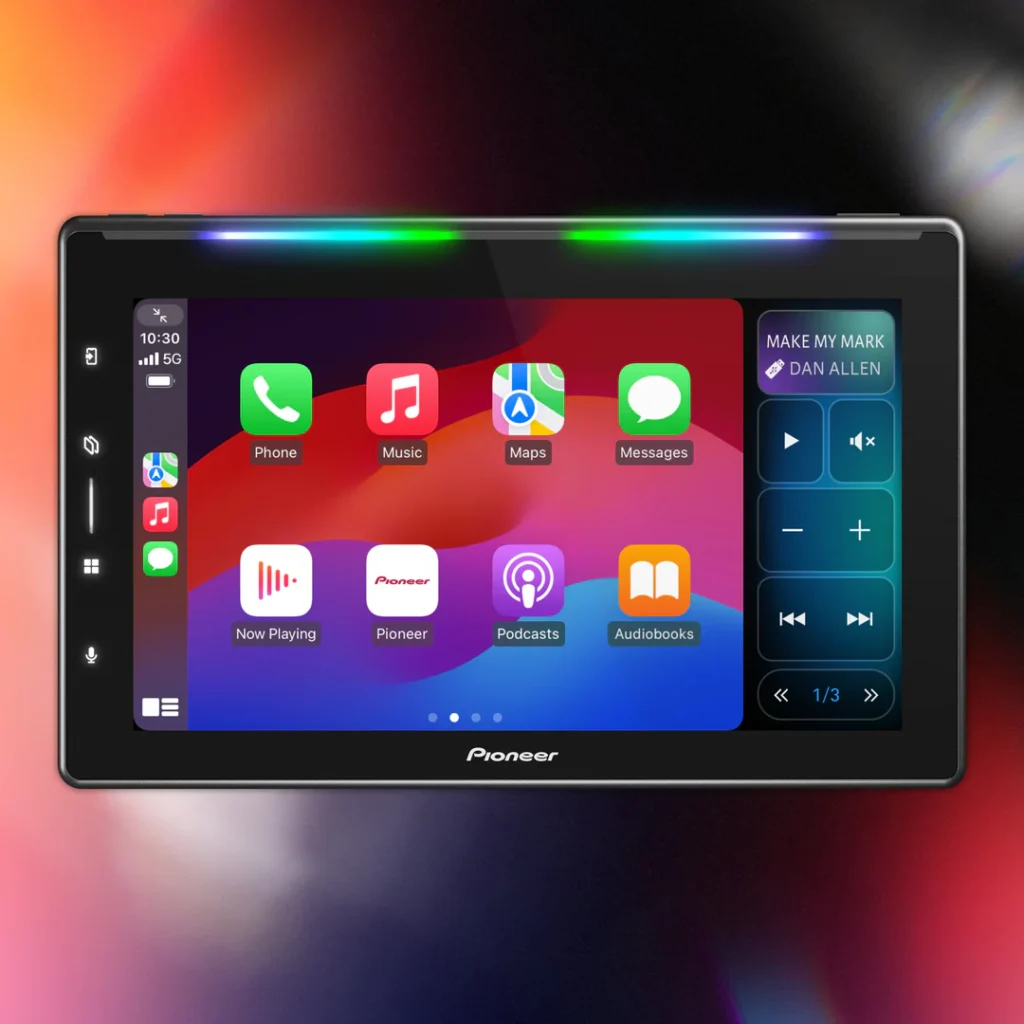
DMH-WT6000NEX Multimedia Car Receiver
The DMH‑WT6000NEX is a premium digital multimedia car receiver with a large 10.1 inch floating capacitive touchscreen designed to modernize your vehicle’s infotainment capabilities, with mobile phone access, music, navigation, and other capabilities.
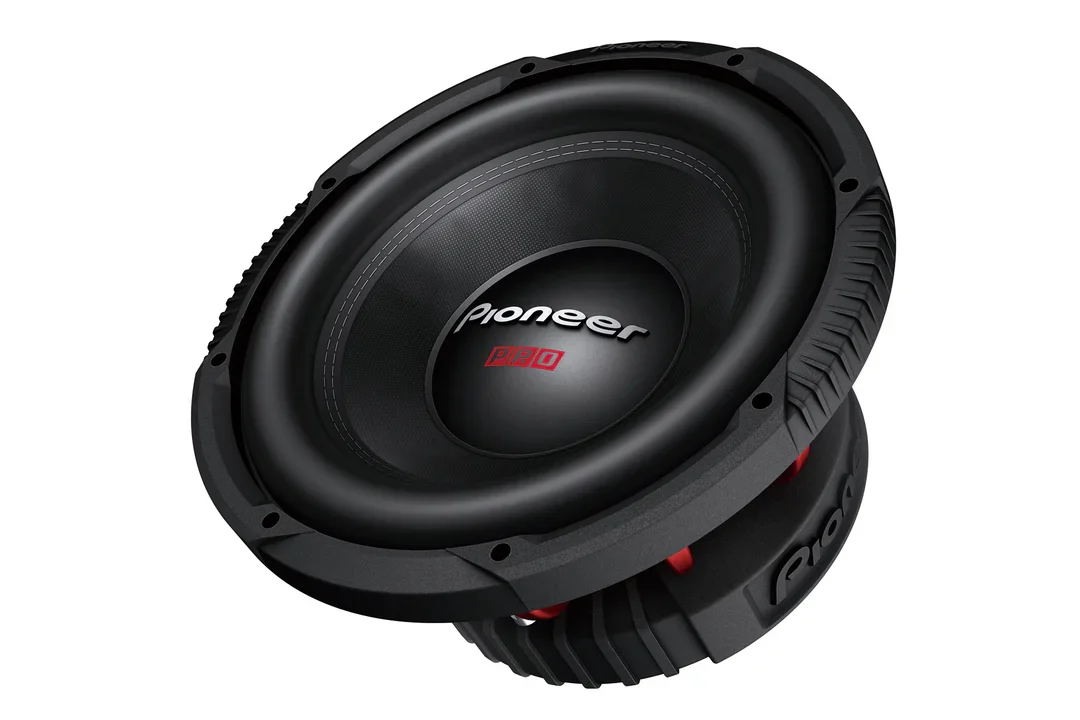
TS-W3020PRO Subwoofer
The TS‑W3020PRO is a 12 inch high-efficiency car audio subwoofer from Pioneer’s “PRO/Samurai series” designed for deep, powerful bass in automotive sound systems.
If you’d like to see all of Pioneer Corporation’s latest automotive products, please follow this link: global.pioneer/en/
Pioneer DJ
The second “survivor” of Pioneer’s breakup is a company called “Pioneer DJ”. It is a major manufacturer in the professional Disc Jockey (DJ) market, making products for nightclubs, bars, recording studios, dance clubs and other settings. They make turntables, headphones, and speakers, as well as specialized DJ equipment such as mixers and samplers. Here are a few of their current products:
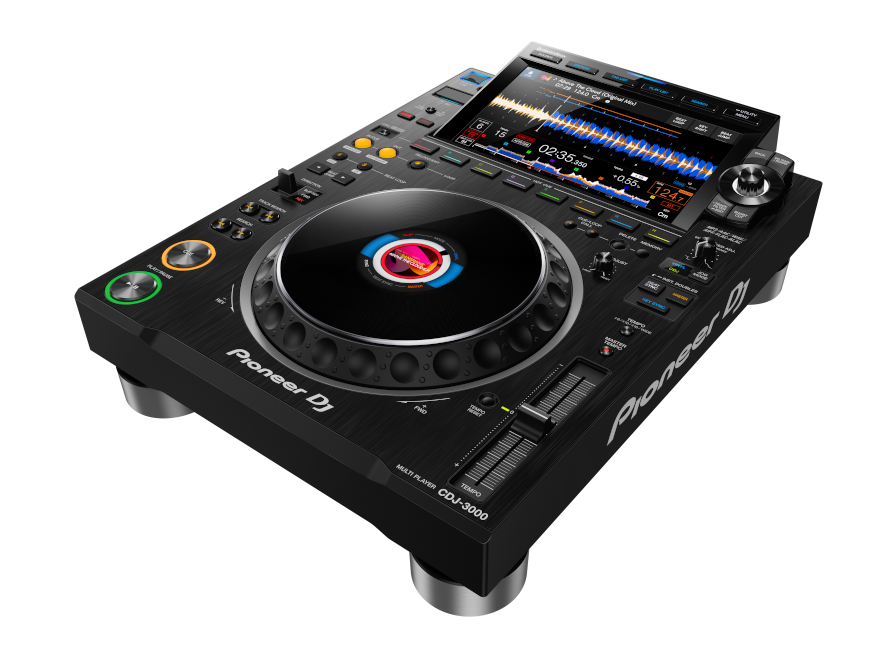
CDJ-3000 DJ Multiplayer
The CDJ-3000 is a professional DJ multiplayer that gives the Disc Jockey total control over the music.
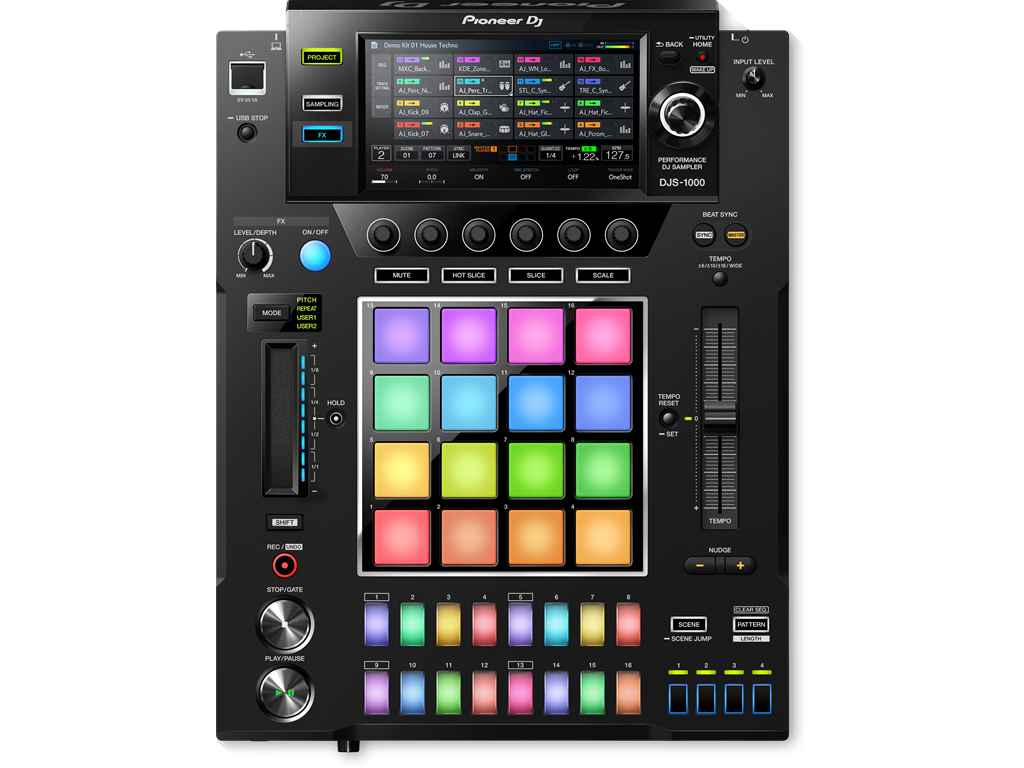
DJS-1000 DJ Sampler
The DJS-1000 is a DJ Sampler enabling live sequencing, beat creation, and performance sampling.
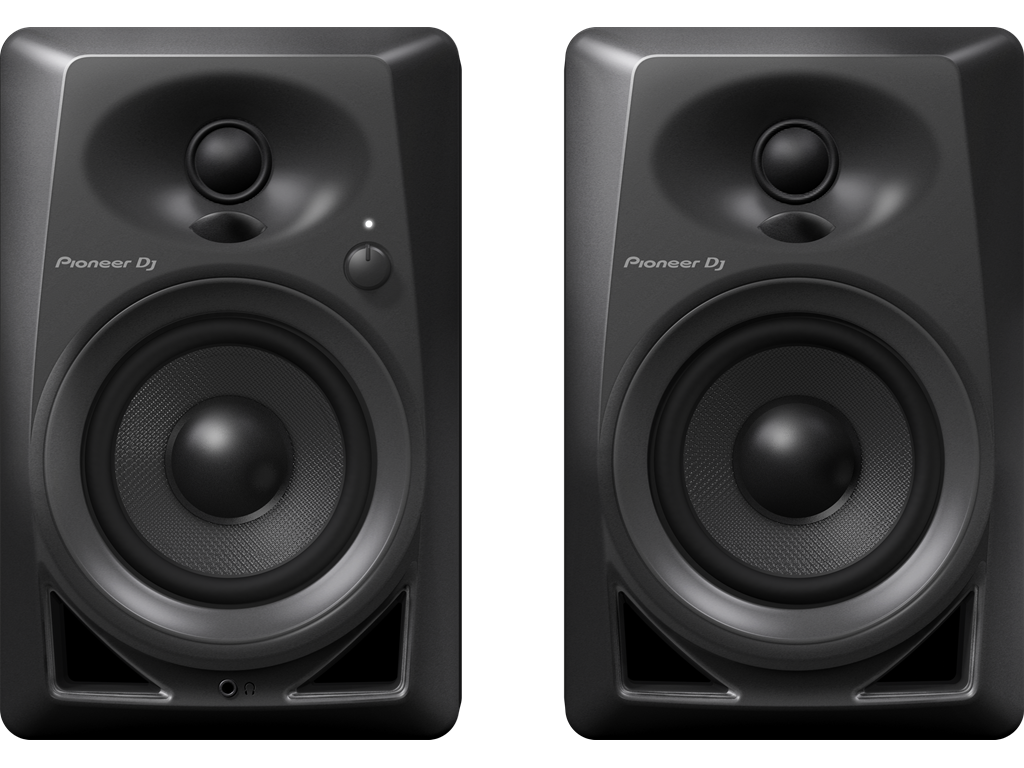
DM-40 Desktop Monitor
Pioneer has been in the speaker business a long time; the DM-40 is a compact desktop monitor speaker designed for DJs and home studios, delivering balanced sound, punchy bass, and clear audio in small spaces.
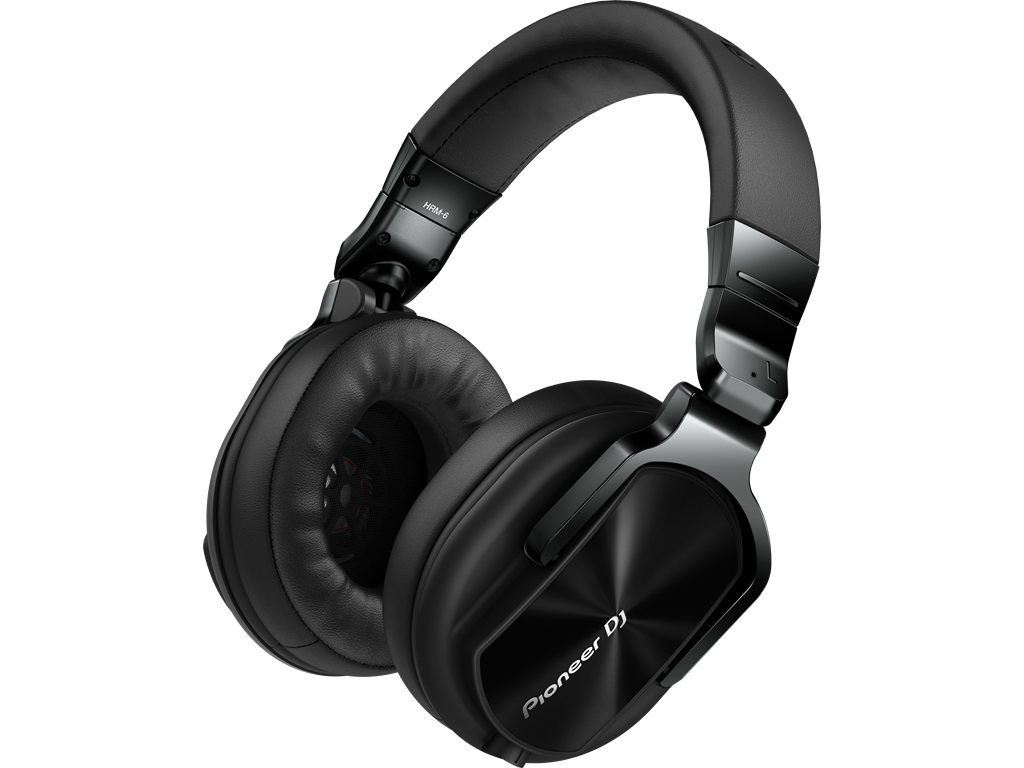
HRM-6 Professional DJ Headphones
The HRM-6 is a professional DJ monitoring headphone offering accurate sound reproduction, robust build quality, comfortable fit, and reliable performance for studio monitoring, mixing, and live DJ use.
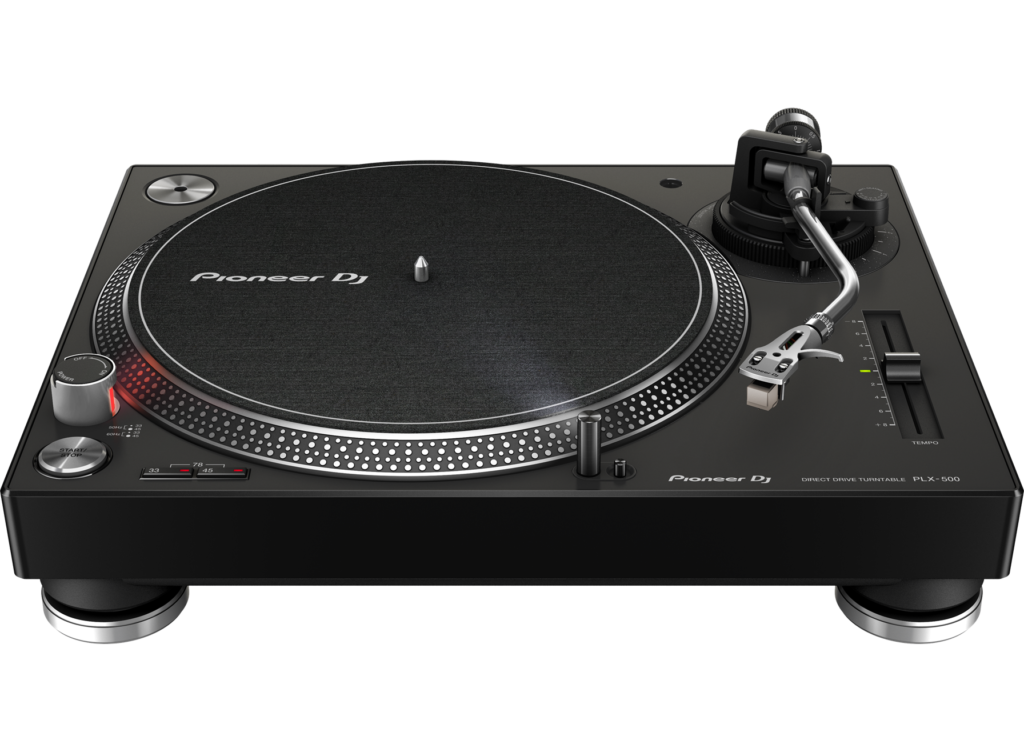
PLX-500K Direct Drive Turntable
The PLX-500K is a direct-drive turntable for DJs and vinyl listening, featuring USB output for digitizing records, solid torque, and classic black styling. Any similarity to the Technics SL-1500 turntable is purely a coincidence!
If you’d like to see all of Pioneer DJ’s latest products, please click here: www.pioneerdj.com/en/
Technical Audio Devices (TAD)
The third and final “survivor” is a company called Technical Audio Devices (TAD), which is the heir to Pioneer’s high end audiophile business. It is the place where the original engineering spirit of Pioneer’s legacy still lives on in the form of world-class Hi-Fi components. Here are a few of their products:
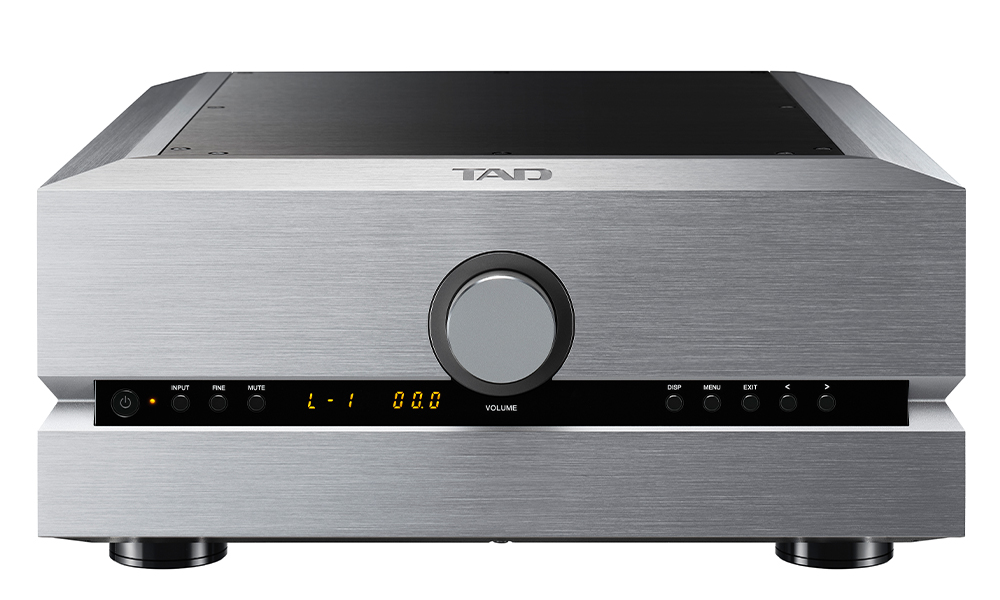
TAD A-1000 Integrated Amplifier
The TAD A-1000 is a high performance integrated amplifier combining refined Japanese engineering with audiophile-grade components. It delivers powerful, low-distortion amplification, exceptional transparency, and precise musical control, reflecting TAD’s studio heritage and commitment to accurate, reference-quality sound reproduction for serious two-channel listening systems.
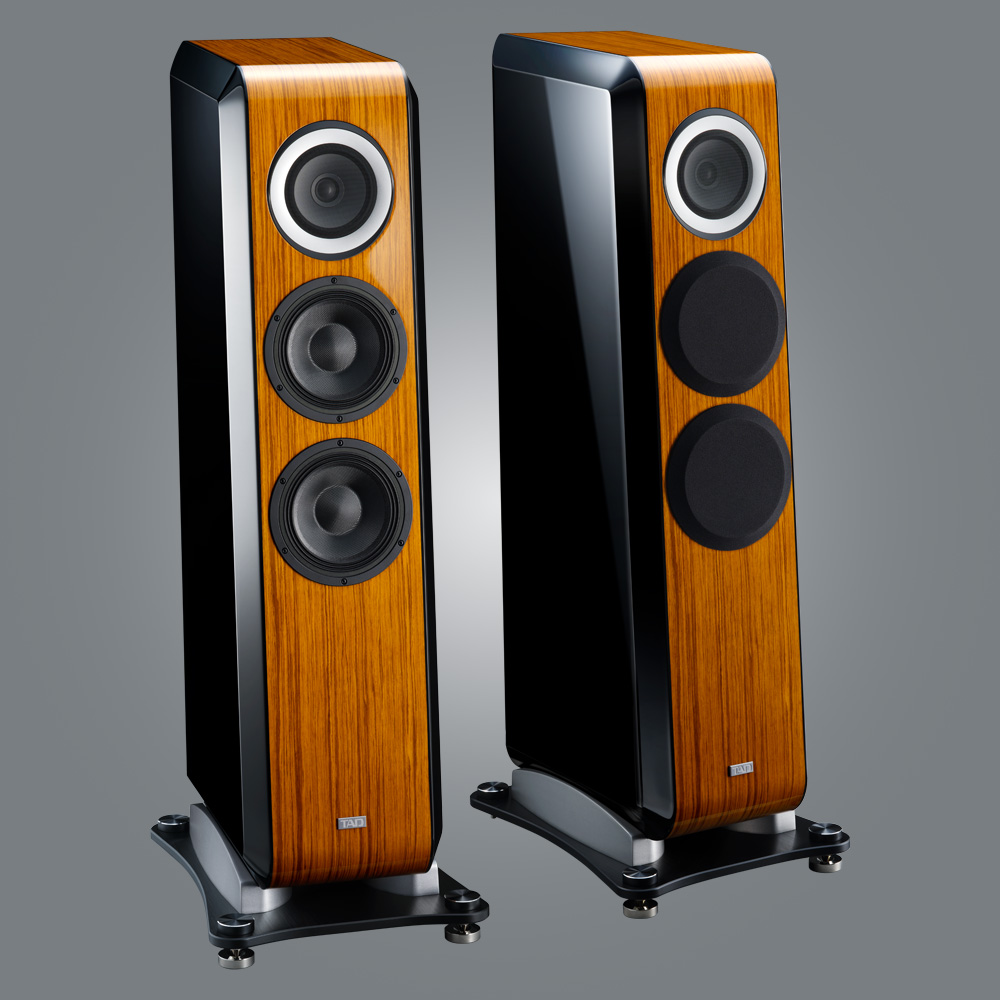
TAD Grand Evolution One (TAD-GE1) Loudspeaker
The TAD Grand Evolution One (TAD-GE1) is a flagship floorstanding loudspeaker featuring a beryllium CST coaxial driver, advanced enclosure design, and exceptional clarity, dynamics, and tonal accuracy, representing TAD’s highest-level pursuit of reference-grade sound reproduction for uncompromising audiophile listening environments.
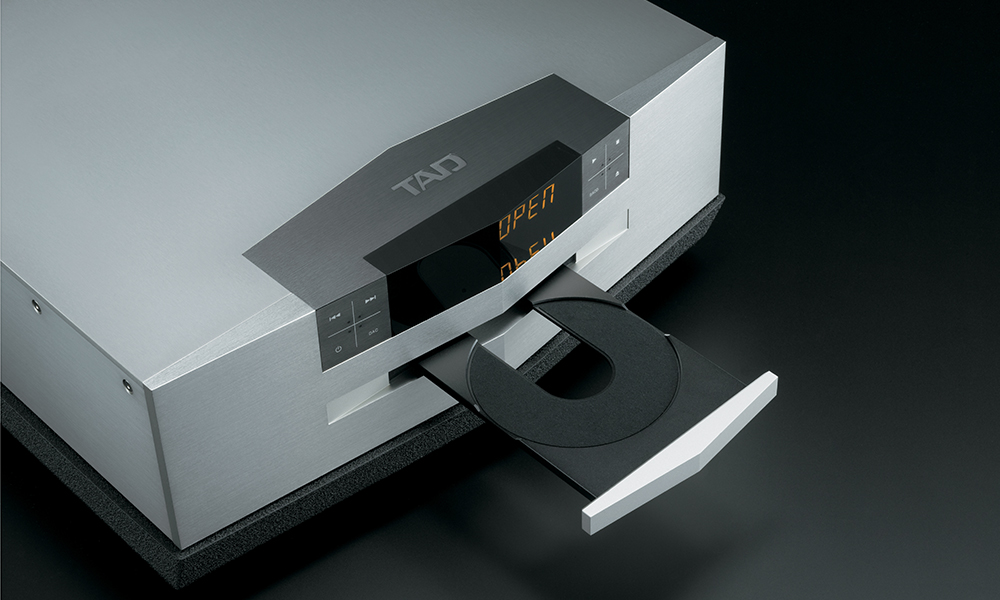
TAD D-700 SACD/CD Player
The Reference Series TAD D-700 is a flagship SACD/CD disc player featuring ultra-precise transport, high-resolution DAC architecture, and exceptional build quality, delivering extraordinary musical detail, timing accuracy, and reference-level sound fidelity for the most demanding audiophile systems.
TAD TL-1601B Loudspeaker
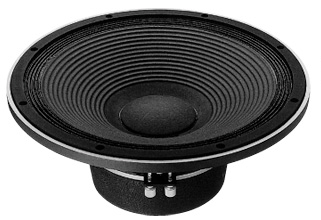
Just like the original 1937 company, TAD makes loudspeaker drivers. The TAD TL-1601B is a professional low-frequency loudspeaker driver featuring a large Alnico magnet, high power handling, and exceptional efficiency, widely respected for its deep, controlled bass and studio-grade accuracy in high-end and professional audio systems.
If you’d like to see TAD’s latest components, please click here: www.technicalaudiodevices.com/
History of Pioneer Electronics
If you’d like to learn more about the rich history of Pioneer Electronics, the company’s website has a fantastic area showing the company’s timeline, along with many of the great products all the way from 1937 to present day.
Just click on this link: global.pioneer/en/corp/info/history/
Pioneer Electronics Induction into the Hi-Fi Hall of Fame
Pioneer Electronics is one of Hi-Fi’s most iconic brands. Starting in Japan in 1937, the company expanded to become a global powerhouse with a wide range of products.
They excelled at just about every category: amplifiers, turntables, speakers, headphones, and disc players. They offered affordable products, mainstream products, and high end products employing exotic technologies and materials. They were also “early adopters” of many technologies.
From their early products in the 1950s and 1960s, the “Silver Era” of the 1970s, the digital equipment of the 1980s, right up until the company’s demise in 2015, Pioneer Hi-Fi equipment was always beautifully crafted, high performing, and great value.
Today, the company’s legacy is kept alive in the three surviving companies Pioneer Automotive, Pioneer DJ, and Technical Audio Devices (TAD). You can clearly see echoes of Pioneer’s past in the products from these companies.
For all of these reasons. Pioneer Electronics is inducted into the Hi-Fi Hall of Fame.
Nozomu Matsumoto